

Listen to the audio version of this article (generated by AI).
United Methodist Oregon-Idaho Conference votes to move 2027 meeting out of Idaho, cites LGBTQ+ and immigrant safety concerns
After a close and emotional vote, Bishop Cedrick Bridgeforth says the decision reflects the conference “wrestling in real time” with how to protect vulnerable members — while Idaho clergy warn the move risks abandoning the queer and immigrant United Methodists who live there.
By Micah Yip | For FāVS News
Citing dangers to LGBTQ+ and immigrant communities, the Oregon-Idaho Conference of the United Methodist Church voted last month to move next year’s annual conference out of Idaho.
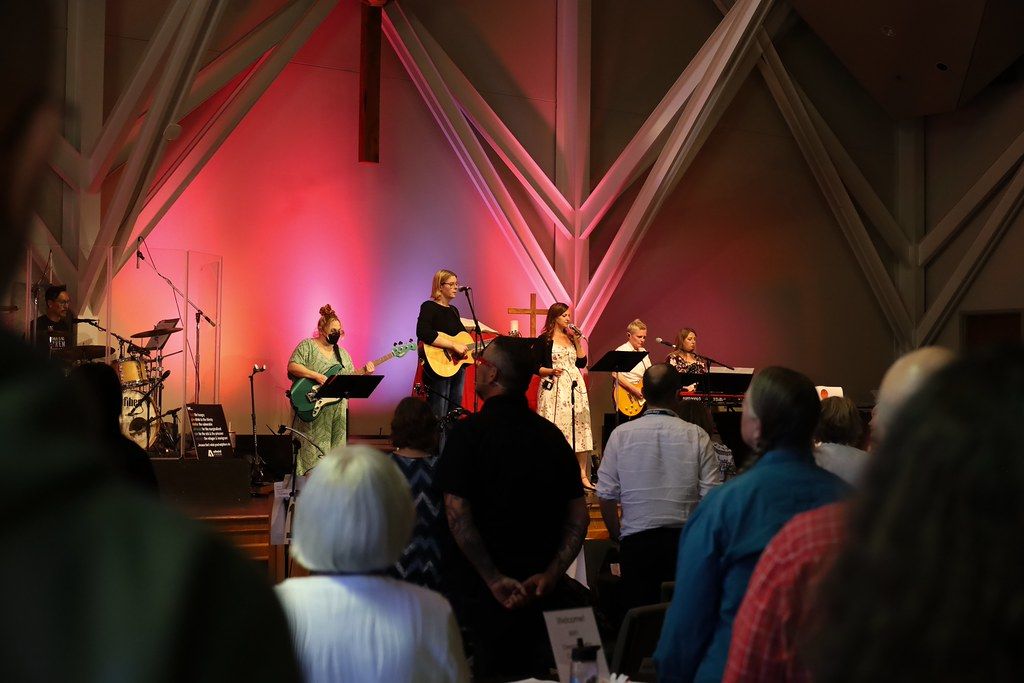
At this year’s annual conference — a meeting where representatives from Oregon and southern Idaho United Methodist churches gather to vote on and make decisions — held at the Cathedral of the Rockies in Boise, Idaho, the Rev. Heather Riggs of Montavilla United Methodist in Portland brought a motion to the floor to change the location of next year’s conference.
Dozens of clergy and laity gave public comment, arguing why they believed the event should remain in Idaho or move to Oregon in 2027. The vote was close, but the end result was that the conference would either move to Oregon or be held virtually.
Why Idaho’s anti-LGBTQ+ laws drove the vote
A previous vote had determined the meeting would be held in Idaho for 2026 and 2027. The Oregon-Idaho Conference merged in 1969, and according to Cathedral of the Rockies pastor, the Rev. Duane Anders, a policy was set that the conference would gather in Idaho about every four years to maintain equity.
A conservative state, Idaho has passed and continues to pass legislation targeting marginalized groups, such as queer and trans folks. The ACLU of Idaho reported that in 2026, 11 anti-LGBTQ+ bills were introduced by Idaho lawmakers, half of which specifically targeted trans people.
For instance, this year’s House Bill 752 “makes it a crime for transgender people to enter restrooms and changing rooms aligned with their gender in government-owned buildings and all private businesses open to the public across Idaho,” the ACLU said. (HB 752 is not fully in effect yet because a federal judge granted a preliminary injunction.)
That climate is what brought the motion to the floor. The catalyst was a specific incident: During public comment, it was reported that a nonbinary clergy member from Oregon experienced a microaggression while accompanying their wife to a local Boise hospital.
Those who wanted the conference to stay in Idaho said they understand the fear LGBTQ+ and immigrant members may feel in conservative Idaho, but they said it’s important to maintain a progressive church presence and safe space in those exact conservative places.
Anders is one such member. When the decision was made for his church to host the conference, it was met with immediate hesitation from some, he said.
He said some colleagues and local church members questioned whether the conference should be held in Idaho given the state’s recent wave of legislation targeting marginalized groups.
“Our response to that was, if anything, we need it here more,” he said.
Anders said he understands the fear that those at the conference were feeling. He’s the father of a transgender daughter who now lives in Washington state because she feels unsafe in Idaho.
At the same time, there are still LGBTQ+ people and people of color in Idaho who Anders hopes his church’s presence reaches, and it’s why he believes progressive churches should stay engaged rather than step back.
“We get that there are risks — there’s always risks in the work of justice. And really, it’s those of us that are privileged that should maybe take the greater risk,” Anders said. “It’s hard to ask our people in the LGBT community to take the risk and say, you should come to Idaho to make us better. I would say that’s a very personal decision. You should only come if you feel safe, and the fact that you don’t feel safe breaks my heart.”
Some Idaho clergy say they feel abandoned
The Rev. Hannah Andres of Whitney United Methodist Church in Boise and the Wesley Foundation at Boise State University said it was heartbreaking to watch the debate. As far as she’s aware, she’s one of only two openly queer clergy currently serving in Idaho from the Oregon-Idaho Conference. She validates those who feel scared, but says it’s hard not to feel abandoned when the general feeling over the years is that nobody wants to come to Idaho.
“It’s hard to not feel disregarded or left behind,” Andres said. “There is really important ministry that we are doing as the Methodist church in Idaho and in eastern Oregon that feels constantly disregarded and like it doesn’t matter.”
For Andres, it’s one example of a broader pattern she’s felt for years: Idaho’s churches doing important work that goes unrecognized.
“There’s a lot of really incredible, faithful people outside of just clergy in Idaho who are trying to do the work and continue to hear it’s not worth investing in this place,” Andres said.

Bishop Cedrick D. Bridgeforth — who leads the Greater Northwest Episcopal Area, which includes the Oregon-Idaho, Pacific Northwest and Alaska conferences — said the following week that he’s still processing the vote. To him, the close margin isn’t evidence of a divided conference so much as a conference wrestling, in real time, with competing obligations to different vulnerable groups.
“It’s not an Idaho versus Oregon thing,” Bridgeforth said. “It’s: how do we protect those that need to be protected?”
Still, Bridgeforth said the process itself fell short of the conference’s stated theme for the gathering, “Love Boldly.” Queer and immigrant United Methodists actually living and serving in Idaho weren’t a part of the conversation that decided where their conference would meet.
“There was a discussion about, but not with,” Bridgeforth said.
In a letter to the conference posted the night of the vote, Bridgeforth wrote that the close outcome “reflects the complexity, pain, conviction and concern present among us,” adding that the conference does “not want to abandon our witness in Idaho, nor do we want to abandon those who are doing the work of love in places where that work is costly.”
What’s next for queer and immigrant united methodists in idaho
Asked what he’d say to queer and nonwhite United Methodists in Idaho who might feel the conference declared their home state too dangerous, Bridgeforth didn’t dismiss the fear.
“For some, it’s too dangerous, and that’s the hard truth. But some of us are called to serve in Idaho,” he said. “… Historically, institutions are always a decade to a decade and a half behind where local communities and leaders are. We need those prophetic voices in all those places across Idaho, just like we need them in every other place.”
This article was corrected to include updated information on a virtual option for next year’s conference.
FāVS News uses professional journalists and thoughtful commentary to explore faith, values and ethics. Support journalism like this by making a tax-deductible donation. FāVS is a 501(c)(3) nonprofit. © FāVS News. All rights reserved. Reproduction permitted only to authorized media partners or with written permission.

