

Listen to the audio version of this article (generated by AI).
Rick Steves, Lutheran bishop to speak on Christian nationalism, democracy in Seattle
In a public forum on democracy and religion author Rick Steves and Bishop Shelley Bryan Wee — both Lutherans— warn Christian nationalists are distorting faith for political gain.
By Morgen White | FāVS News Reporter
Main Points
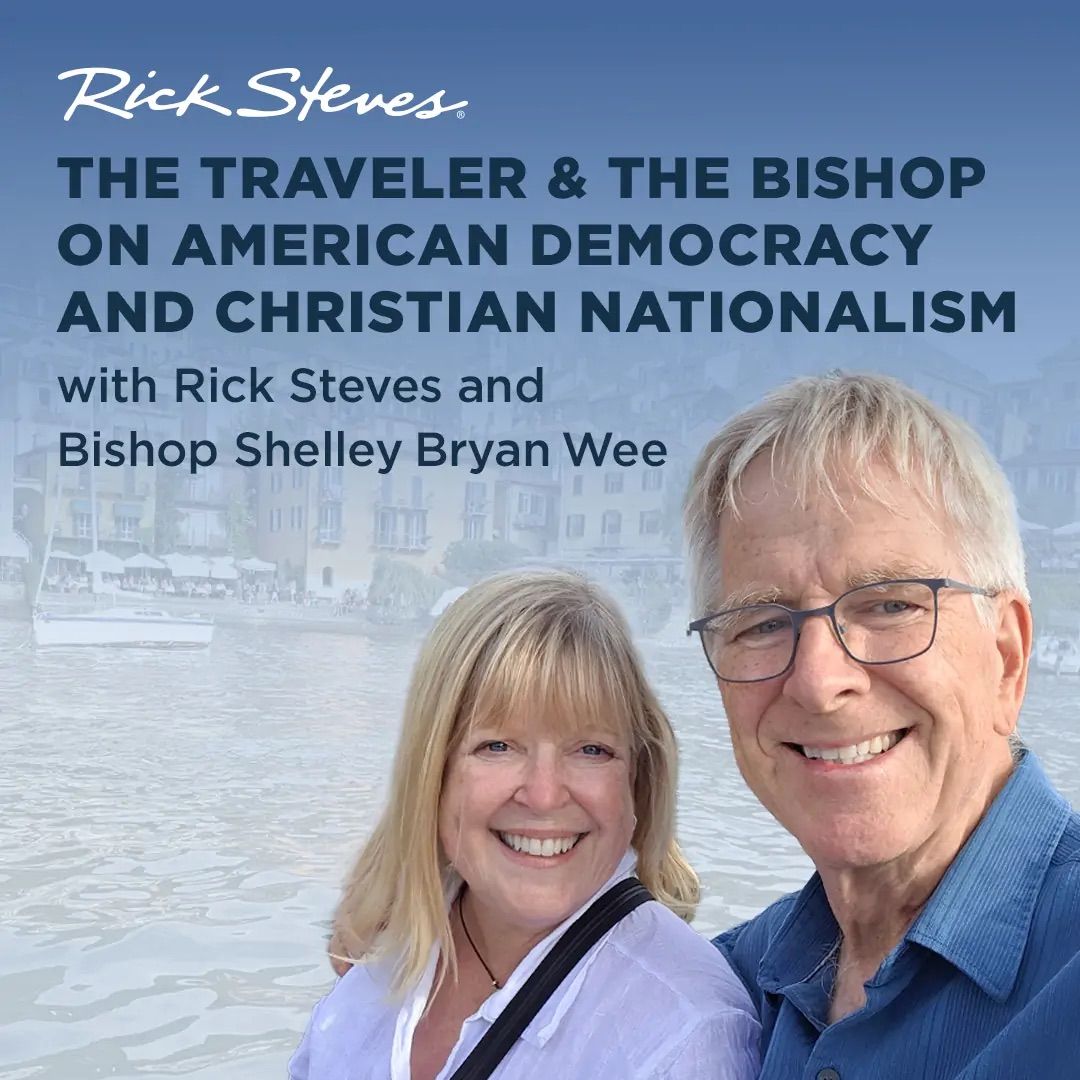
On April 26, Saint Mark’s Episcopal Cathedral will host travel writer Rick Steves and Bishop Shelley Bryan Wee of the Northwest Washington Synod for a talk on the state of American democracy and Christian nationalism.
Steves will speak about how leaders are stealing his faith and using it against Christians like him for political purposes. He pointed specifically to President Donald Trump hugging the American flag on church altars on multiple occasions.
“Shelley and I, as Christians, are offended by political operatives that take advantage of people’s faith and pervert it into a political action to win their votes,” Steves said. “And that’s exactly the insidious evil nature of Christian nationalism. We can see that this is not a partisan squabble, but a defense of our democracy.”
Two sessions added to meet demand
Originally, “The Traveler and the Bishop on the State of America’s Democracy” was to be one talk at 6 p.m. When that slot was filled to capacity, organizers added the 4 p.m. session to accommodate demand.
There will also be a virtual option for the 6 p.m. talk. All ways of participating are free and open to the public, but registration is required if you plan to attend in person.
The talks are a continuation from Steves’ and Bryan Wee’s discussion when they spoke at the Edmonds Center for Arts in January.
COVID and shared faith brought them together
Steves and Bryan Wee crossed paths through their connection to the Lutheran faith, and they have been together since December 2019. Their relationship was accelerated after becoming a pod during the COVID-19 pandemic, navigating the responsibilities that came with being leaders in a rapidly changing world.
For Steves that meant figuring out what to do as an employer of 100. For Bryan Wee that meant adjusting leadership and continuing worship access virtually for 107 congregations, a part of the Northwest Washington Synod of the ELCA.
“It was the first time in my life I’ve ever eaten at the same table, for a year, with the same person,” Steves said.
That time period was quite the adjustment for Steves whose life revolves around travel and who believes you learn more about your home by leaving it and looking at it from a distance.
Together they fight Christian nationalism
“I’ve had a fire in my belly for this kind of stuff for a long time. I produced a show about fascism. I was inspired to do that when President Bush was in office,” Steves said. “I knew we had latent fascist tendencies in this country like I think any country has, and we have to keep an eye on that. We got to know what it is when it raises its head.”
Bryan Wee found herself faced with Christian nationalism before the term was a part of her vocabulary.
“Where I’ve seen Christian nationalism is when holidays that are national are sometimes lifted up into the spiritual realm. I’m not talking about people who love their country and who are faithful people,” Bryan Wee said.
Bryan Wee would have disagreements with people within her congregation as a young pastor about how to commemorate patriotic holidays, such as the Fourth of July, Memorial Day and Veterans Day.
“It’s not that I didn’t want to have a prayer for the country or to remember those who fought in different wars. It’s different than putting together that this country, the United States, is more important or more special in God’s eyes than any other country or people in the world,” Bryan Wee said.
Christian nationalism predates the term
While the term Christian nationalism has become mainstream in more recent years, the concept dates back to the beginning of U.S. history.
“Do we celebrate that Christian nationalism has been a part of the United States? Or do we grieve that Christian nationalism has always been a part of the United States,” Bryan Wee said.
At a town hall in Moscow Idaho two weeks ago Doug Wilson, joined by two other pastors Jared Longshore and Toby Sumpter, outlined their vision for America’s future. During which, Sumpter said Christian nationalism is America being what it was founded to be.
“If you look at the founders of the United States, who are also fallible human beings, and yet, when the United States of America was formed, the idea was not to be a theocracy, it was not to be a Christian state. It was formed, with a higher ideal of people coming together from so many different perspectives,” Bryan Wee said.
These days, different perspectives within a community space can be harder to come by. Bryan Wee says this is something that we are missing in our world, and a gap that was historically filled by religious institutions.
That said, Bryan Wee still draws a line between different perspectives and hate.
“It’s the followers that I’m concerned about,” she said. “I think as a Christian, I am called to speak against Christian nationalism. Just as a white person, I am called to speak against white supremacy,” Bryan Wee said.
She added that there is no need to understand Wilson before calling him out.
“We need to speak the hard truth because Doug Wilson isn’t just in some other bubble. I don’t need to understand him because I don’t need to know more about misogyny, and I don’t need to know more about racism,” Bryan Wee said.
FāVS News uses professional journalists and thoughtful commentary to explore faith, values and ethics. Support journalism like this by making a tax-deductible donation. FāVS is a 501(c)(3) nonprofit. © FāVS News. All rights reserved. Reproduction permitted only to authorized media partners or with written permission.


Thank you for this reporting. As someone from Moscow, it makes me glad that Wilson et al can serve as a foil against which true Christians can define themselves. As a Lutheran, it makes me happy to see fellow Lutherans speaking up for our faith and our country.