

Guest Column By Scott Rasmussen | FāVS News
If you missed the Spokane Symphony Chorale and Chamber Singers performing Handel’s Messiah at the Cathedral of St. John the Evangelist recently, put a reminder on your calendar to get tickets next year. The performance was sublime. But more than the performance itself, it was thinking about how it came to be that made it special to me this year.
At intermission I read the bios of the soloists and other performers and was delighted to learn that many grew up here in Spokane. Others came to Spokane after distinguished music careers in other parts of the country and around the world. Still others call Oregon, Montana or other parts of Washington home and were here just for the weekend to share their talents.
It was this mix of people from different places, races, religions, orientations and I imagine even political ideologies that stood out to me.
The musicians played different instruments or sang a different part — each contributing their best to make magnificent music. You need to have different instruments in order to make the music work, but the fact of there being a diverse set of instruments and voices isn’t enough on its own.
A performance like that only works when everyone feels welcome to contribute to the best of their ability. Each musician felt invited to willingly share their talent to serve and bless our community. It was beautiful, moving, and inspiring.
A community of diverse voices
When I got home from the concert, my phone flashed a notification about the story of a City councilwoman from Spokane Valley who posted on her private Facebook page that she is a “proud Islamaphobe.” I thought the notification must have been a typo. It wasn’t.
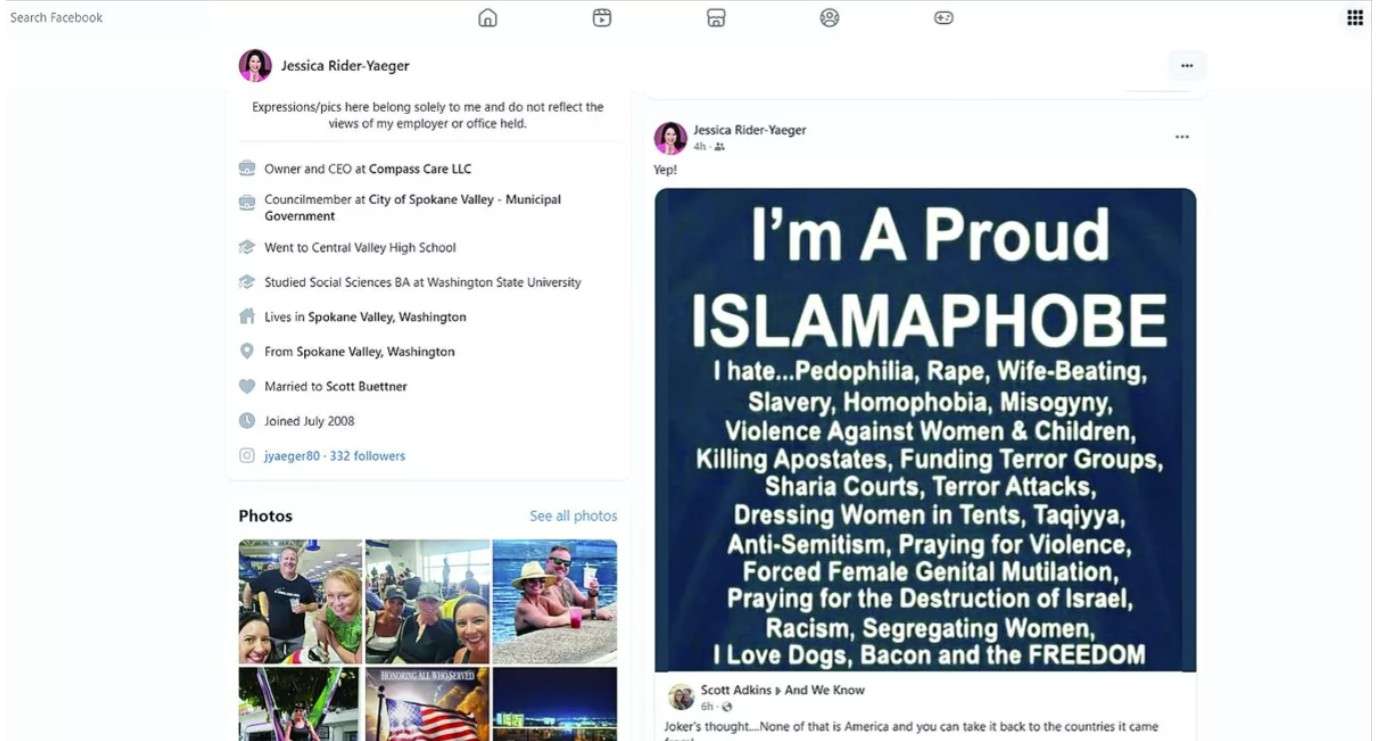
According to media reports she posted, in part, “I’m a proud Islamaphobe. I hate … Pedophilia, Rape, Wife-Beating, and Slavery…” seeming to equate Islam with these terrible plagues.
The willingness of anyone, but particularly a public official, to proudly declare themselves as fearing or holding prejudice against Islam is dumbfounding. Even more so when you realize that as a City councilwoman she represents the entire city, including Muslims who worship at the Spokane Islamic Center, which is in Spokane Valley city limits.
She doubled down by releasing a statement to the media that said, “Let me be absolutely clear: pedophilia is wrong, rape is wrong, female genital mutilation is wrong. These are not controversial positions. They are universal human rights and truths. Anyone pretending that speaking out against these atrocities is somehow hateful or extreme is being deliberately dishonest.”
As near as I can tell, no one is disputing that pedophilia, rape or female genital mutilation are wrong. Nor is anyone contending that speaking out against them is hateful. If there are specific instances of anyone committing these atrocities, particularly in our community, then we are all under an obligation to speak out against them and work through legal means to bring perpetrators to justice.
What is hateful is to deliberately — and proudly — describe yourself as an Islamaphobe. By definition you are declaring that you hate Islam and Muslims.
We live in a community of differences. Everyday we interact with people who look, think, worship and vote differently than we do. That diversity is a fact.
We also live under a Constitution that guarantees the freedom of religion, speech, press, assembly and the right to petition the government. But as these comments demonstrate, the fact of diversity and the legal protections aren’t enough to ensure that everyone feels equally welcome and empowered to participate and contribute in our community.
When we demean, belittle or exclude a group of people, for whatever reason, we draw lines between “us” and them.” We create an environment of fear and uncertainty. We become more invested in defending our side than we are in building the kind of community we all want to live in.
The problem with prejudice
As a Christian, I think often about what Paul wrote to the first century Corinthians: “For as the body is one, and hath many members, and all the members of that one body, being many, are one body … And the eye cannot say unto the hand, I have no need of thee: nor again the head to the feet, I have no need of you.”
In other words, our community is made up of many members who are all different from each other. Whatever our differences, we are all contributors to making our community safe and prosperous for everyone. It breaks down if we tell one group — “We don’t need you!” or “You aren’t welcome here.”
I think back to the symphony. If the director told the cellos they weren’t needed. Sure, they could keep playing but in the back of their mind the other musicians are wondering if they are next on the chopping block. Perhaps they hesitate to play or stop showing up at all.
It isn’t enough to acknowledge our diversity. And it isn’t even enough to have constitutional and legal protections. Unless — and until — we take seriously the fact that we live in a world where people are different than we are, we choose to respect the fundamental dignity of each individual and we learn to collaborate in a way that centers our shared values, we will be stuck in this polarizing rut.
We will give way to fear, hatred and prejudice. We will live with the threat of violence rather than the promise of peace.
This Thanksgiving season, I’m grateful and amazed for the musicians in the symphony and their performance. Even more so, I’m grateful for the example of HOW they did it — choosing to understand the importance of each of their contributions and coming together around a shared purpose to make magnificent music. I am hopeful our community can learn to do the same.
The views expressed in this opinion column are those of the author. They do not necessarily reflect the views of FāVS News. FāVS News values diverse perspectives and thoughtful analysis on matters of faith and spirituality.
Never miss a story. Get the top headlines, breaking news, commentaries, and handpicked favorites delivered straight to your inbox every morning. Subscribe to our quick, free and informative FāVS News Daily Newsletter.

