

[box type=”note” align=”” class=”” width=””]Mindfulness A to Z: 108 Insights for Awakening Now By Arnie Kozak Wisdom Publications, 2015 233 pp., $16.95[/box]
Millions of people extol the benefits of mindfulness – consciously living in the moment rather than dwelling in the past or worrying about the future.
Books, magazines, newspapers and retreat centers trumpet the growing popularity of meditation and mindfulness, which can lead to greater happiness, less suffering and more acceptance of even the difficult parts of life.
Arnie Kozak, the author of “Mindfulness A to Z,” is an experienced retreat leader who teaches at the University of Vermont College of Medicine.
Kozak came up with 108 topics with at least one for each letter of the alphabet. Among the chapter titles: Anger, Buddhism, Compassion, Death, Fantasy, Gratitude, Pain, Quiet and Sangha. In case you wonder about the Z chapter, it is Zafu, the cushion some people use when they sit in meditation.
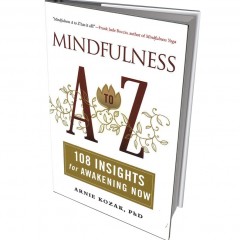 One of the appealing features of this well-written book is the author’s use of personal anecdotes. The implicit message is that even for long-time practitioners, living in the moment can be a daily challenge. Kozak describes his distress when he was on a silent retreat meditating when someone’s alarm clock sounded. He had to remind himself that the sound of the clock was simply part of the present moment – no cause for worry, judgment or anxiety.
In the Grasping chapter, Kozak describes his frustration when he bought a new computer, then learned that a faster model was available, causing him to feel “angry, crestfallen and frustrated.” He then acknowledges the “if only” fallacy: If only he had a faster computer, he would be happy.
Kozak makes a useful distinction between pain and suffering. Pain is inevitable in life. Everyone will encounter illness, aging and death – no exceptions. However, the suffering part is caused by the mind’s reaction to pain.
The author calls himself a secular Buddhist, believing that Buddhism, like other religions, “can be pre-scientific and superstitious.”
In the Distraction chapter Kozak rails against smartphones and other forms of electronic communication that take us out of the present moment. He recommends that readers set aside a period each day when they put away their smartphones and tune in to the moment.
The book cautions that the mind is always roaming. “Rather than seeing things for what they are, we’re always thinking how they could be better, or how this moment compares with some other [moment].”
Kozak urges readers to eat mindfully, taking a few moments to appreciate the food we have before we begin eating. He admits to not always following his own advice. “Truthfully, I am even munching on my morning cereal as I write this.”
Dividing mindfulness into more than 100 topics is a bit artificial. This is not a book to be read cover to cover like a novel. One approach might be to read one chapter at a time and see how that chapter’s wisdom applies to the reader’s life. Another approach would be to scan the table of contents and read chapters that pique the reader’s interest. If readers are experiencing anger, fear or judgment, they might read those chapters first.
“Mindfulness A to Z” offers useful snippets of wisdom regarding mindful living, a lifelong pursuit that is well worth the effort.


Anybody can learn to meditate. You do not need to lay on the floor in lotus-position. It simply involves a brief period of absolute tranquility, during which time you make every effort to think of absolutely nothing
You can search on google for Denise Reeves guide meditation nirvana to get the book which I used to help with learning meditation.
Thank you one million and please continue the gratifying work.