

Listen to the audio version of this article (generated by AI).
Ancient Buddhist sutra recited aloud in English for first time at Washington monastery
Sravasti Abbey in Newport, Washington, hosted a world premiere “resounding” of the Prajñāpāramitā Sutra in Eight-Thousand Lines May 27–31, marking the first-ever English recitation of one of Buddhism’s most significant scriptures.
By Ven. Tenzin Tsepal | FāVS News Columnist
The views expressed in this opinion column are those of the author. They do not necessarily reflect the views of FāVS News.
Sravasti Abbey Buddhist monastery in Newport, Washington, is still reverberating from a world premiere “resounding,” a recitation of the Prajñāpāramitā Sutra in Eight-Thousand Lines, held May 27-31. One of the most important and influential of all Buddhist scriptures, it’s a wonder this sutra has only recently been fully translated into English.
The principles taught in the sutra have been shared since Buddhism’s entry into the English-speaking world, but for some Buddhists, this first-ever English reading was like touching the very source of the teachings.
Prajñāpāramitā means “the Perfection of Wisdom,” or “Transcendental Knowledge.” It describes a special kind of wisdom that helps people see reality more clearly. It is also the name of a collection of Buddhist texts. For over 2,500 years, people have read, chanted and studied The Prajñāpāramitā Sutra in Eight-Thousand Lines as a way to learn and practice the extent of Buddha’s teachings.

A gathering of monastics and laypeople
About 60–70 nuns, monks and lay practitioners gathered at the Abbey — with more than 1,700 people watching online — to recite the text. Spoken aloud in three, two-hour sessions each day for four days, the unison recitation ended on Vesak (or Saka Dawa Duchen in Tibetan), the Buddhist holy day celebrating the birth, enlightenment and passing away of Buddhism’s first teacher, Shakyamuni Buddha.
The “resounding” was a collaborative effort between 84,000: translating the words of the Buddha and Sravasti Abbey. 84,000 is a team dedicated to translating the entire Tibetan Buddhist canon and making it freely available in English.
Each session was ably led by Ven. Konchog Norbu, the copy editor at 84,000, whose visit to the Abbey three years ago planted the seed for this collaboration.
He said, “Traditionally, the Perfection of Wisdom, the whole body of literature, is sponsored to be recited by monastics in its entirety to clear obstacles and to bring auspicious conditions. If someone wanted to sponsor monastics to recite The Perfection of Wisdom in Eight Thousand Lines in English, that’s now possible.”
Sessions were interspersed with short talks by Professor Greg Seton, the main translator of this text, Nathaniel Rich, research editor and translator at 84,000, as well as Ven. Thubten Chodron, founder and abbess of Sravasti Abbey, that enriched our understanding and purpose for reciting the scripture.
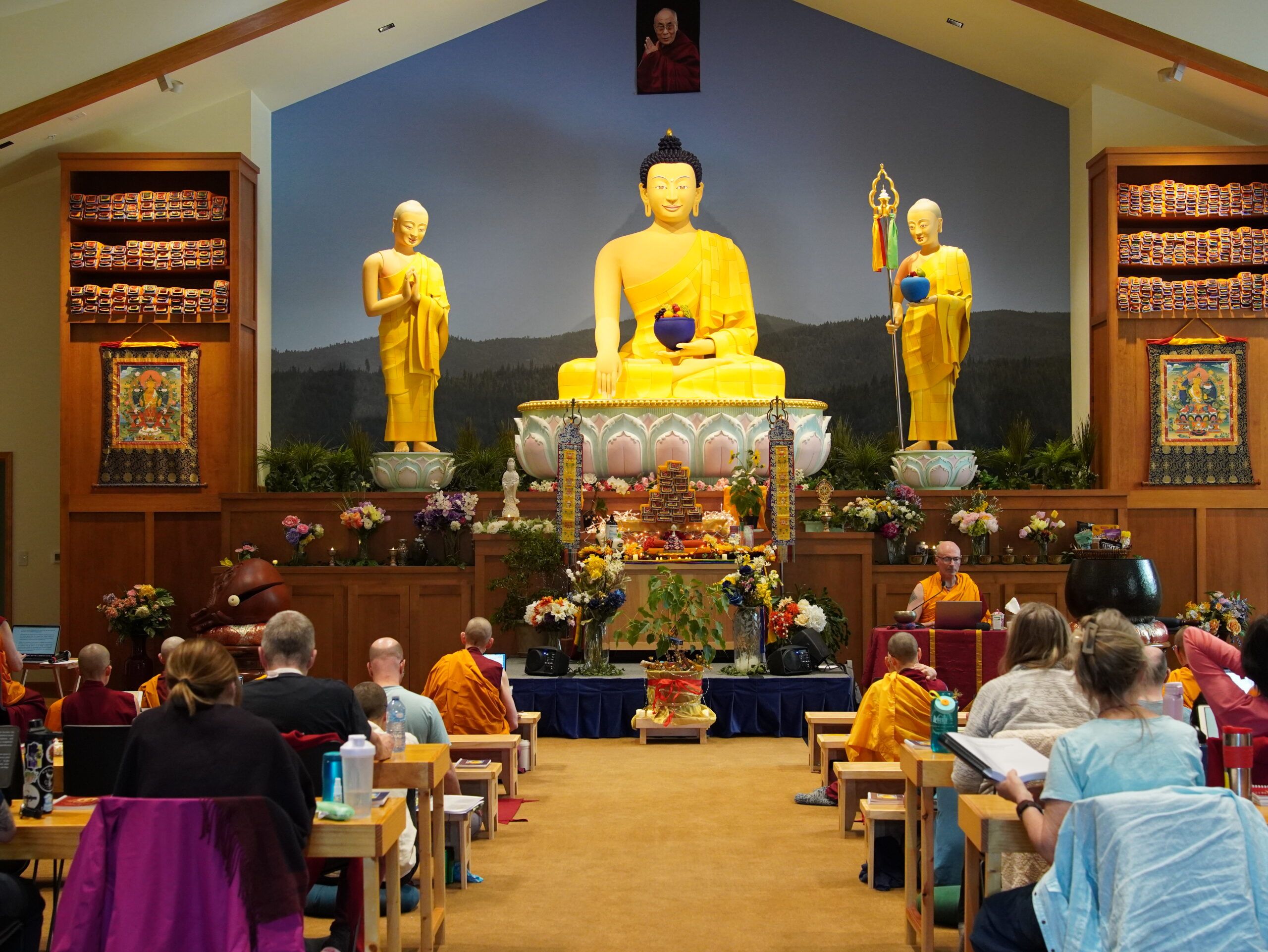
‘Like getting to know the Buddha’
To have one’s mind immersed in such a virtuous activity over four consecutive days had a diversity of effects. Reciters reported feeling deeply peaceful, inspired, purified, renewed, awe-struck and humbled.
Ven. Thubten Ngawang, an abbey monk, said, “Reading this sutra has been like getting to know the Buddha and his disciples. If the statues on the altar could talk, this is what they would say.”
Although the Perfection of Wisdom in Eight Thousand Lines is a very difficult scripture to understand, its recitation nevertheless touched the hearts of participants, allowing its deeper themes and spiritual significance to resonate beyond the limits of intellectual comprehension.
As a lay student from Palouse said, “While some may find such a long recitation daunting, I found it to be exhilarating, energizing, inspirational and an extraordinarily meaningful spiritual exercise. It felt like a rare privilege of being in the presence of Shakyamuni Buddha and other transcendent disciples while they engaged in lively conversation, discussing and clarifying this complex sutra.”
FāVS News uses professional journalists and thoughtful commentary to explore faith, values and ethics. Support journalism like this by making a tax-deductible donation. FāVS is a 501(c)(3) nonprofit. © FāVS News. All rights reserved. Reproduction permitted only to authorized media partners or with written permission.

