

By Morgen White |FaVS News Reporter
Amid widening political divides, around 50 people filed into Holy Spirit Lutheran Church in Kirkland last Tuesday for a bridge-building event.
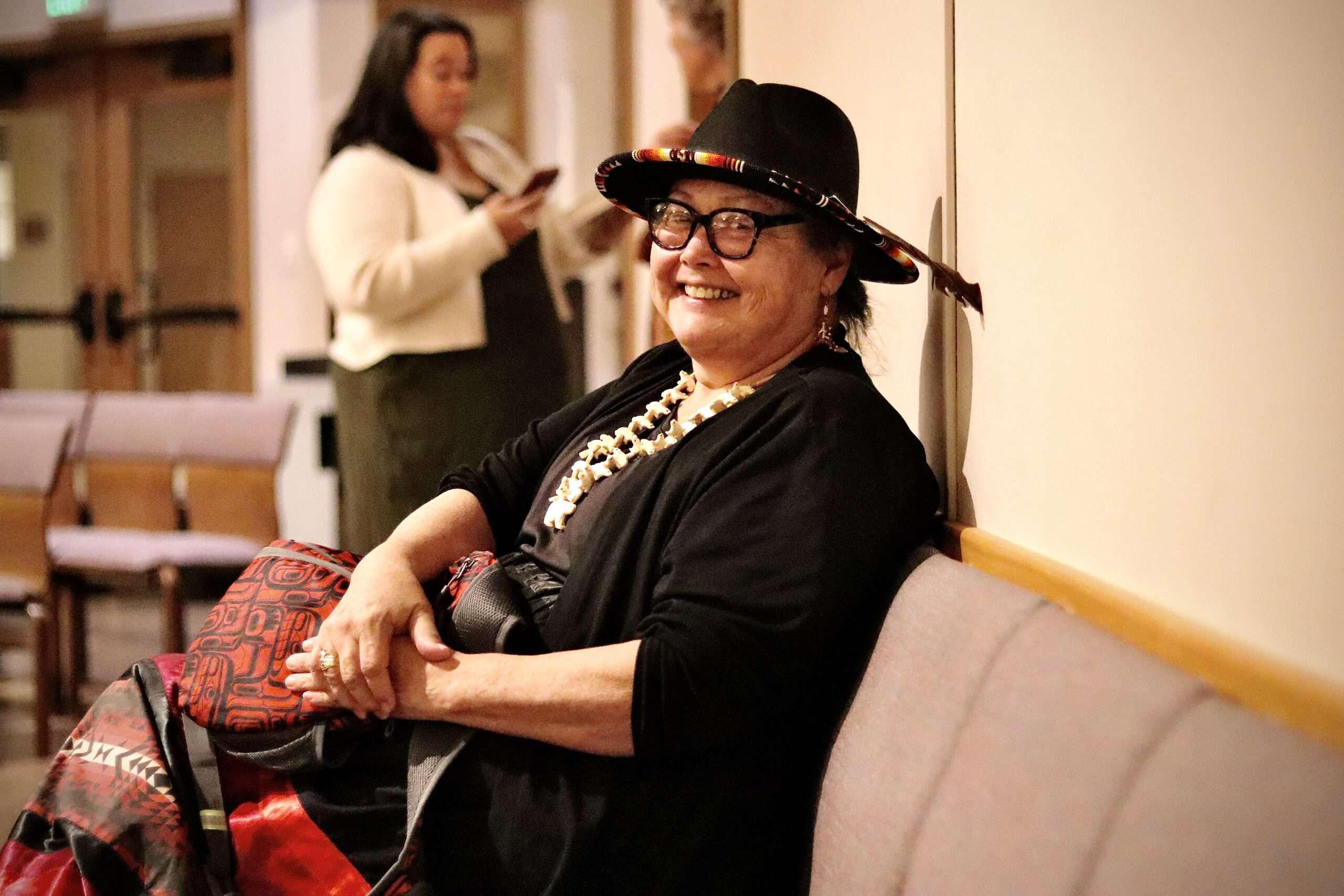
Living on the Edge: Finding Our Way Forward Together kicked off at 7 p.m. with an introduction from the Rev. Katy McCallum Sachse, the church’s lead pastor, followed by a blessing originally by elder Vi Hilbert in Lushootseed, read by Kay Knott, an elder of the Upper Skagit Tribe.
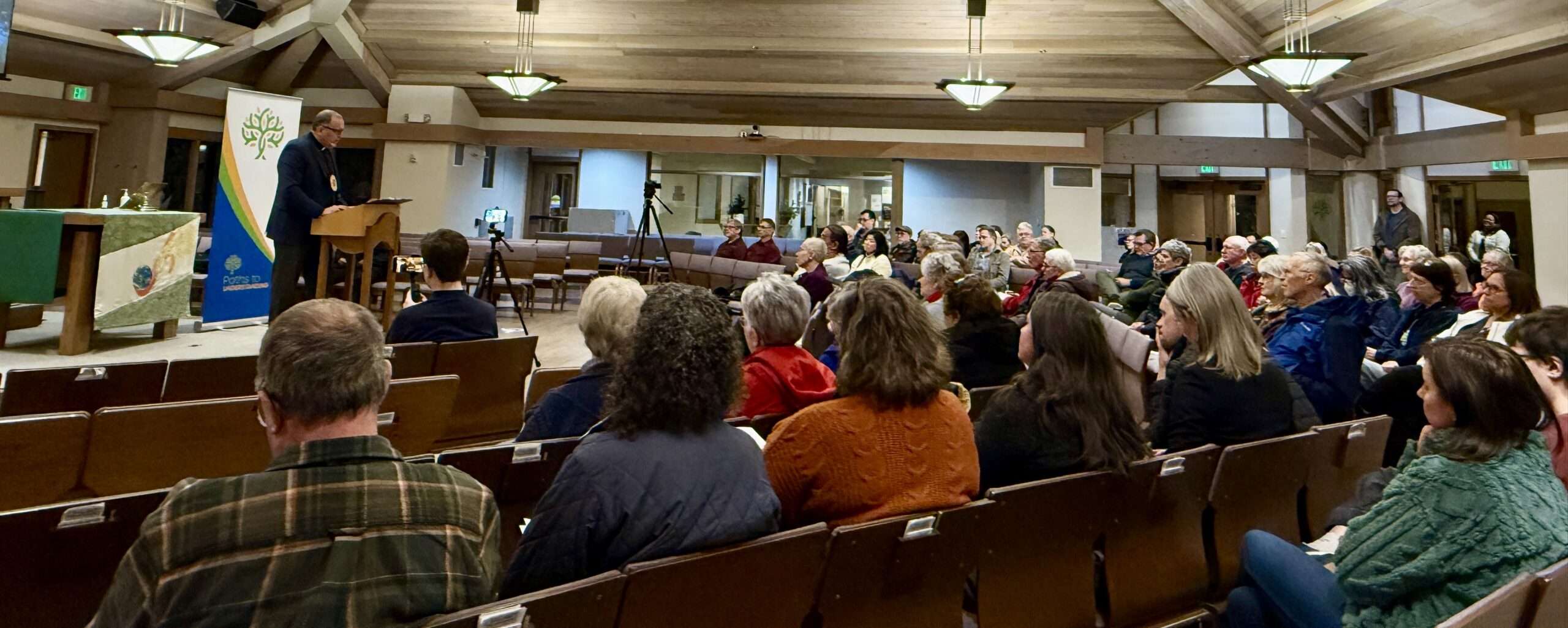
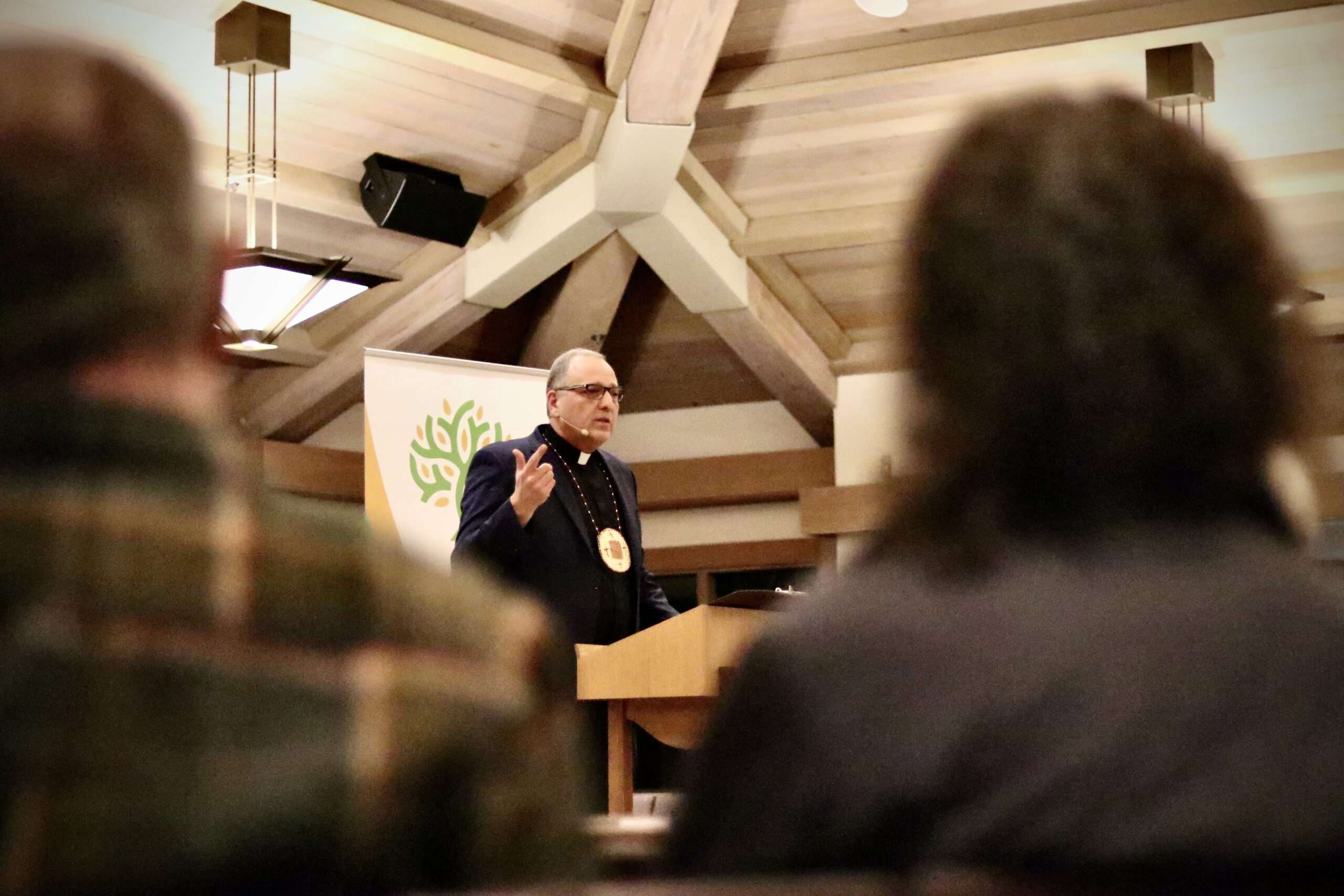
Then the Rev. Terry Kyllo, executive director of Paths To Understanding, took the stage, thanking the crowd and asking everyone to take a deep breath.
Behind Paths To Understanding
McCallum Sachse and Kyllo are both Lutheran pastors, with Kyllo also serving Episcopal churches. Holy Spirit has hosted PTU events in the past.
“Terry has preached and taught classes here, and we have really appreciated his ability to connect us to other faith communities,” McCallum Sachse said.
PTU is a Washington-based nonprofit that envisions a world where everyone can thrive — where everyone belongs and all groups work together toward the common good. They pursue that vision by gathering neighborhoods together to grow trust, which aligns with Holy Spirit Lutheran Church’s mission.
“We want to be a community that builds bigger tables in a world of higher walls — across religions, across ages, across ethnicities and race and gender. We want to be a place where people can come together and be at the same table. We don’t all have to agree, but we all have a place,” McCallum Sachse said.
Kyllo has helped churches and nonprofits restructure and recover after significant problems. He applied that work to an organization called Treacy Levine Center, originally called Camp Brotherhood.
“It was an interfaith camp just north of Arlington, beautiful place, beautiful vision, but they had kind of lost their way and they sold the camp,” Kyllo said. “They ended up inviting me to come in and help them. How do we do this kind of interfaith work? How do we see how we help create unity in the human family? That was their motto, without a building, without the camp.”
That organization became PTU in 2020.
Kyllo’s interest in theology and interfaith topics began long before he became PTU’s executive director. As a child, he attended a small Lutheran congregation outside of LaCrosse, Washington.
He recalled a congregant questioning how his mom could have been diagnosed with multiple sclerosis if he was really a good Christian.
“There were lots of Christian churches where people would have said something like that — that if you’re a good person, God kind of works things out for you, and if you’re a bad person bad things happen to you,” Kyllo said. “I didn’t buy into the shame. In Sunday school class that led me to be the kid that would ask the pastor questions.”
Later, when Kyllo attended seminary in Chicago, he took a class about the Lutheran Church’s role in the Holocaust.
“I remember saying it in the cafeteria downstairs: If I ever see that kind of thing happening when I’m a pastor, I don’t want to be a quiet one,” Kyllo said. “I know the history of how Lutherans failed to stand up for our Jewish neighbors. When you get a dynamic of dehumanization at work in a country it never just stays toward one group, it metastasizes to more and more and more and more groups. People get more and more divided. We begin to get more and more suspicious of each other, and it can lead to societal breakdown.”
After talking with people from diverse faith backgrounds, Kyllo concluded that everyone feels under threat and misunderstood.
“About a year ago it just sort of hit me that everybody’s there, and it’s not that the reality of the threat is the same for each group, but when you’re under threat, when you feel vulnerable, it shapes all your perceptions,” Kyllo said.
These perceptions lead people to see only attacks toward their own ingroup, making their primary focus protecting themselves and others like them. But this results in further isolation from other groups. Social media exacerbates the issue, Kyllo said, since people constantly hear about each other from third parties.
“Third parties that use algorithms to keep us hooked, because it feeds us something about a group that’s threatening our group, and so we think we’re protecting our group when we’re actually participating in a process of mutual destruction,” Kyllo said.
This is human nature being hacked and used against us, he said.
“We have a tendency to believe the work is easy fluffy work, it’s not,” Kyllo said. “The other tendency is to believe no one else is doing the work so we give up. It’s easy to write the Facebook post, it’s harder to come together.”
After the speech, time was allotted for questions and answers.
Hannah Hochkepple, program director for PTU, gathered note cards passed out for audience members to write their questions, then read them for Kyllo to answer.
One question asked his thoughts on criticism of bridge-building work. Kyllo acknowledged studies show bridge-building work can minimize minority voices.
“But what’s the alternative? Not talking to each other?” Kyllo asked. “A democracy means hearing from every group. The more conversations we have the deeper our belonging.”
Kyllo concluded by encouraging the audience and asking them to sing with him.
“What I sensed in this work of bringing people together, is that once they come together and they see each other as people, it’s like a spell is broken,” Kyllo said. “Our democracy is in real trouble, and yet we have literally everything we need. I think Americans are pretty famous for ignoring problems, but then once we finally see the problem we’re tough to stop.”
Audience reactions
After the event, Jeanne Tate and Laura Kerns stood packing up while chatting. Tate had invited Kerns, who had finished a long day at work and was emotional.
“I work in health care, there’s a lot of disparity in what people can access,” Kerns said.
Kerns pointed to a part of Kyllo’s speech where he discussed societal structures. The pyramid represents fear, control and division, whereas the circle represents a society where everyone belongs and power is shared. Near the end of the speech, Kyllo asked the audience whether they wanted to live in a pyramid society or a circle one.
“It’s like the pyramid thing. The people who get respect are wealthy people. They’re not necessarily caring, compassionate people that are doing it on behalf of others,” Kerns said.
Tate said she came because she had been feeling hopeless and didn’t feel she had been doing enough.
“I’ve been feeling like I needed some inspiration, and I certainly got it,” Tate said. “I need to have my mind way more open than it is. I need to give people a lot more grace than I have, and I need to consider opinions other than my own.”
Knott, who has volunteered with PTU for four years, reflected on one audience question.
“When they ask the question about what’s stopping you from bridge building … it’s fear,” Knott said. “What if you go into a community that you don’t know and say something wrong or do something wrong, or they think something different to me, and it’s often fear. That blessing that Vi gave was probably made after 9/11 and it holds such strength. We need each other. So, you know, kind of suck it up and get over your fears and do a little risk taking, however small or however big, because not everybody can do that, but do something.”
PTU has another bridge-building event planned for February 22nd at Christ the Servant Lutheran Church in Bellingham. It will begin at 7 p.m.
FāVS News uses professional journalists and thoughtful commentary to explore faith, values and ethics. Support journalism like this by making a tax-deductible donation. FāVS is a 501(c)(3) nonprofit.

