

Idaho faith leaders push back against transgender bathroom law amid legal battle
Progressive Idaho faith leaders are challenging a new transgender bathroom law, raising questions about religious freedom, church exemptions and the role of faith in the debate.
By Emma Maple | FāVS News Reporter
This piece was copublished with Sojourners, an independent, award-winning magazine of faith, culture, and politics.
Progressive religious leaders in Idaho are pushing back against a new state law that would force transgender people to use bathrooms aligned with their sex assigned at birth, a measure that is partially on hold following a preliminary injunction issued in June.
House Bill 752, which was scheduled to go into full effect on July 1, would require people to use bathrooms, locker rooms and other sex-segregated facilities matching their sex at birth, with criminal penalties for those who don’t comply.
Six transgender Idahoans challenged the law in federal court, and a federal judge issued a temporary order predicting it would not survive legal scrutiny. The injunction also ruled that transgender people can use restrooms of their choosing, if a single stall restroom is not readily available.
The state’s attorney general said he plans to appeal.
Although the law is backed by conservative Christians and was drafted by a legislature that opens most meetings with a Christian prayer, many progressive religious leaders have said it is unrepresentative of their faith and are speaking out against it. Some are also wrestling with separate questions: Does the bill apply to religious institutions, and should it?
Progressive religious leaders take a stand
One day after Gov. Brad Little signed HB 752 into law, around 30 progressive people of faith marched into the governor’s office singing “songs of justice and resistance” and demanding a meeting with the governor, according to Boise First United Church of Christ Pastor, Rev. Josh Lee.
Those people then camped outside the governor’s office for six hours until the building closed, Lee said. Law enforcement asked them to leave, but 9 people refused, according to Boise Unitarian Universalist Fellowship Minister Sara LaWall.
“We felt really angry and frustrated,” LaWall said.
Those who did not leave were arrested, charged with trespassing and taken to jail. They are currently in the process of fighting their criminal charges in court, LaWall said.
The sit-in and civil disobedience was a public outcry by people of faith against the bill, organized in conjunction with Interfaith Justice Idaho, a grassroots coalition of people from various faith communities including Christianity, Islam and Judaism.
The United Church of Christ said in an interview that it opposes the legislation and believes that transgender people are “made in the image and likeness of God, and as a result, like all people, deserve dignity and respect,” according to Rushad Thomas, a member of the UCC Office of Public Policy & Advocacy team.
The Presbyterian Church (U.S.A.) does not appear to have taken a public stance advocating against the bill, and did not respond to a request for comment. The Episcopal Church’s national press office directed FāVS to the Episcopal Church in Idaho, who did not respond to a request.
But in Idaho, LaWall and other progressive leaders say their faith and theology of inclusion make support of transgender Idahoans an easy decision.
“It’s just not of huge concern for us to tell people who they are,” Rabbi Johanna Hershenson, who leads Ahavath Beth Israel in Boise, said. The idea of gender existing outside of a binary dates back centuries and is referenced in the Talmud, the central text that lays out Jewish law and tradition, she added. Other progressive religious leaders agree that a spectrum of genders are referenced and supported in historic religious texts.
“I like to say that inclusion includes everybody,” Hershenson said. “Like every other aspect of society, sometimes that’s challenging, but to us that’s absolutely essential.”
Following the sit-in, public religious advocacy against the bill appears to have hit a standstill while the state works its way through the legal process. Lee said the interfaith coalition is in a “holding pattern.”
“There’s not much we can do besides try to help people be as informed as possible,” he said.
In the meantime, most progressive religious institutions are focused on sharing information about their stance on the bill. The Boise First United Church of Christ has joined in on a bathroom map, which is being created by Idaho nonprofit Trans Affirm, that will show transgender people where they can find a bathroom without risk of being criminalized, according to Lee.
In the past, progressive religious leaders have said they oppose the bill on religious grounds, believing that the bill is antithetical to religious commandments to love others and protect marginalized people.
LaWall said one of the primary reasons she advocates against bills like the transgender bathroom bill is to represent the “liberal religious argument.”
“Oftentimes, laws like these are done in the name of religion,” she said. “And oftentimes, not all religions subscribe to that.”
Conservative Christians say bathroom bill upholds their faith
Blaine Conzatti, president of the Idaho Family Policy Center, a Christian conservative policy organization that calls itself the largest one in the state, takes a different view of the law. He believes that God created every human as distinctly male or distinctly female; to him, that means every person has dignity that the opposite sex cannot intrude on, a dignity he feels HB 752 supports.
“That’s why we have so many laws on the books helping to ensure the privacy and safety of all people, but especially women and girls,” Conzatti said, referencing laws passed in 2023 and 2025 that require transgender people in primary school and college to use the bathroom that aligns with their birth sex.
The Idaho Family Policy Center supports its position in word and in practice. This year, legislators used some language from a previous bill championed by the Idaho Family Policy Center in the bathroom bill that was passed. The center has also drafted similar legislation in the past that would have addressed the issue through civil rather than criminal means, Conzatti said.
The big debate: Does the bill apply to religious institutions?
While Conzatti says he thinks churches have a moral obligation to enforce the law to “protect the privacy and safety of women,” he said he doesn’t think the law applies to church property — a question that has become one of the central points of consideration among Idaho’s faith communities. Conzatti did not answer whether he believed the law should apply to churches or whether such a restriction would be a violation of a church’s religious freedoms.
While the legal and ideological battles tied to the bill are playing out, Lee said many faith communities are trying to get a clear answer to that question.
The bill, as written, applies to both government spaces, like city halls and libraries, as well as privately-owned places that act as places of “public accommodation,” defined by Idaho code as a “business, accommodation, refreshment, entertainment, recreation, or transportation facility of any kind, whether licensed or not, whose goods, services, facilities, privileges, advantages or accommodations are extended, offered, sold, or otherwise made available to the public.”
Professor Richard Seamon, who teaches constitutional law at the University of Idaho, said the answer to that question depends on how the term “public accommodation” is used. Because the law does not specifically address whether churches qualify under that term or not, Seamon said that question is left up to legal interpretation.
In federal anti-discrimination lawsuits, Seamon said, courts have generally held that churches are not places of public accommodation. He said his educated guess is that, in this situation, churches would likely be exempt from the law. However, he said he was unsure what the situation would be when looking at church-operated businesses like coffee shops, thrift stores, shelters and more. The Supreme Court ruled in 2014, in favor of Hobby Lobby, that religiously oriented businesses do have rights under the Religious Freedom Restoration Act.
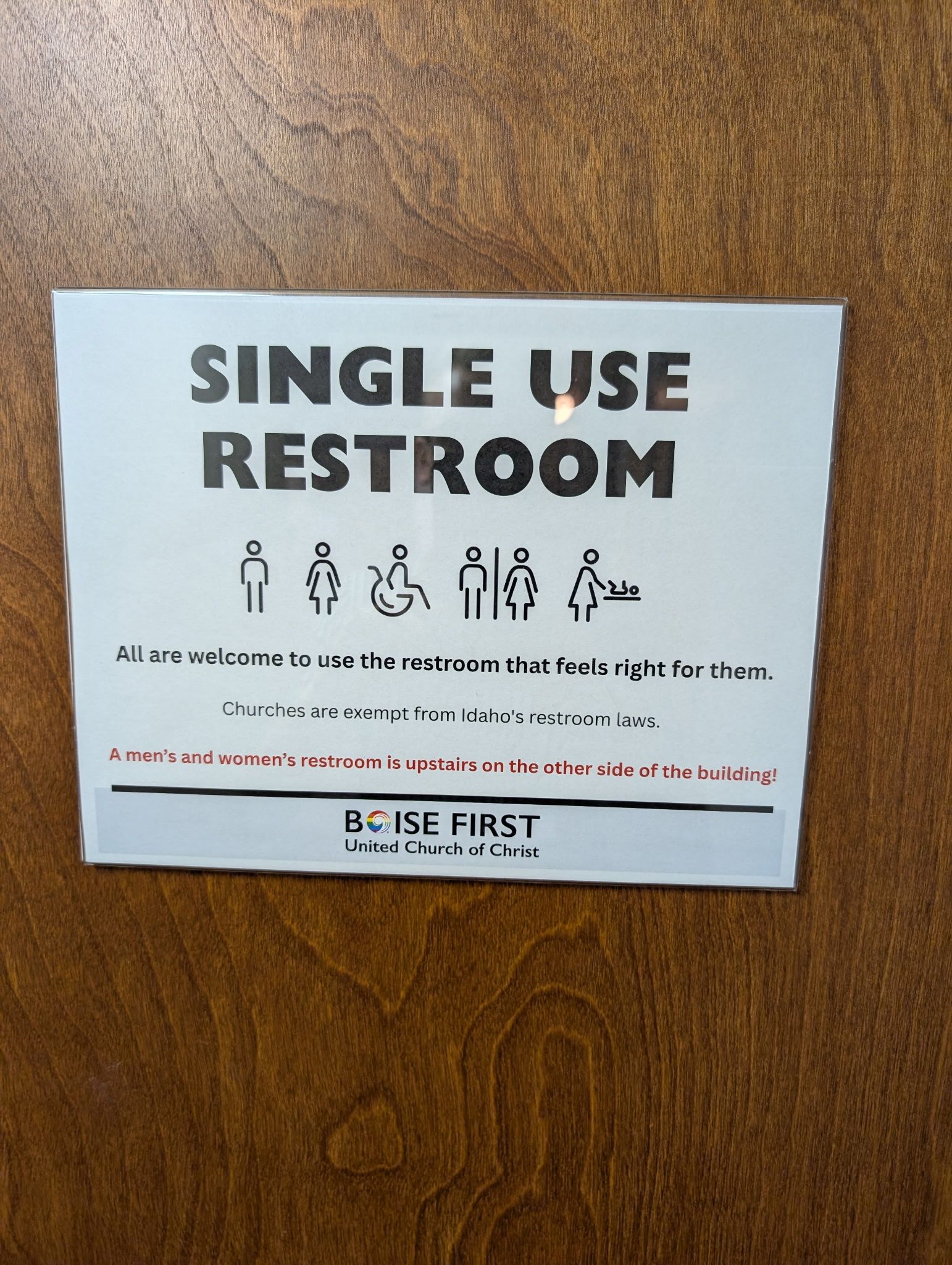
Because churches and religious institutions have the right to turn people away, Lee with the Boise First United Church of Christ said he thinks it could be argued that religious bodies are not places of public accommodation. After talking to attorneys, Lee said his church is operating under the assumption that religious institutions are not places of public accommodation and not bound by the law. In that case, people can legally use whatever restroom they choose when they step through religious doors.
“We are an inclusive church,” Lee said. “We invite people to use whatever bathroom feels most comfortable to them.”
To help inform people, Lee said, the church is putting up new signs that say churches are exempt from the bathroom law.
“All are welcome to use the restroom that feels right for them,” one sign read.
The biggest thing, according to Lee, was “letting trans people know, when they’re in our building, that they don’t have to be afraid of our bathrooms.”
Other churches, like the Immanuel Lutheran Church in Boise, are also receiving conflicting information about applicability from parties like the city, lawyers, architects knowledgeable in building code and other churches. At a round table held in Boise City Hall, Pastor Bob Lewis said city leaders indicated that the law doesn’t apply to churches because they’re not public buildings. Lewis was skeptical of that conclusion, and said he had gotten conflicting opinions from some people inside his congregation.
For now, Lewis said the Immanuel Lutheran Church will direct transgender people to use the gender neutral restroom in the church basement.
Although the preliminary injunction has blocked a portion of the law from going into effect, it does require transgender people to use single-stall gender neutral restrooms where available.
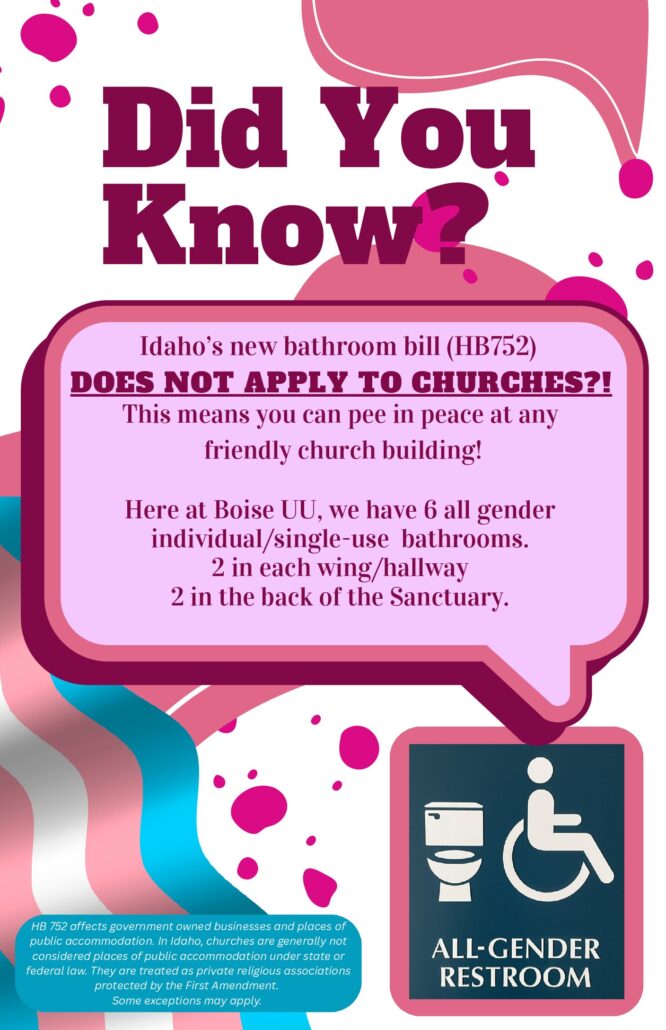
The Boise Unitarian Universalist Fellowship is putting up signs explaining that transgender people do not have to only use gender neutral bathrooms, according to LaWall.
“We have a big sign on all of our bathrooms that clarifies that for people,” LaWall said. She’s also working with progressive faith communities to spread the message that people can use whatever bathroom they are most comfortable with.
“You can pee in any friendly church,” she said.
The bigger debate: Should it apply to religious institutions?
Whether it applies to religious organizations or not, some institutions are asking another question: should it?
“It would be very intrusive upon religious liberty,” Lee said when contemplating whether the bill applied to churches. He added that the Religious Right, which might include some lawmakers in the state capital, were ardent supporters of religious liberty.
“It would be very shocking if faith communities were expected, somehow, to be told what they can or cannot do in their buildings,” Lee said.
Religious freedom is a concept that has often been championed by the Religious Right, but the concept has different implications in different social sectors.
Associate Professor Sam Martin, who studies conservative social movements at Boise State University, said the definition of “religious freedom” often depends on the political leaning of the group using the term.
A secular or progressive understanding of religious freedom tends to mean pluralism, she said — “live and let live.” The Religious Right, by contrast, tends to use the term differently.
“For them, religious freedom is the right to defend and protect and promote a Christian underwriting,” Martin said. “When people try to take God out of it, they are attacking my religious freedom to promote, protect and defend this.”
Martin said that framework traces back to the nation’s earliest religious settlements, which she argues were not built on pluralism but on dissent.
“The concept of religious freedom and pluralism draws a picture that is false, because there was far more animosity and conflict than we remember,” Martin said. Baptists and Puritans, she said, “believed they had the one true religion” and had little tolerance for each other’s practices.
That history, Martin said, still shapes how many conservative Christians understand the concept today: not as a right to choose one’s own beliefs, but as a right to shape the country according to a particular set of values.
“Protecting religious freedom [to many conservative Christians] is protecting the right to create the world in a particular kind of way,” she said.
Progressive religious leaders often push back on the way the religious right have defined and promoted religious freedom. Minister LaWall said it is “disheartening to witness what our legislators are doing in the name of religion,” both locally with bills like the transgender bathroom bill, and on a national stage under the Trump administration.
“On a federal level, we’re fast becoming a theocracy where we’re ruling with one particular religion and with one particular interpretation,” LaWall said. “That feels scary, and it feels very antithetical to the values of this country.”
FāVS News uses professional journalists and thoughtful commentary to explore faith, values and ethics. Support journalism like this by making a tax-deductible donation. FāVS is a 501(c)(3) nonprofit. © FāVS News. All rights reserved. Reproduction permitted only to authorized media partners or with written permission.

