

By Emma Maple | FāVS News Reporter
With just three part-time employees, a Christian foster support organization in the Pacific Northwest is influencing the lives of hundreds of kids each year.
Homes of Hope, located in Lewiston, Idaho, provides two types of support to families that interact with the foster care system: physical resources and counseling services.
The organization offers everything free of charge.
One of Homes of Hope’s goals is to reduce turnover in the foster care system, Director of Counseling and Services Cheryl Allman said.
Around 50% of foster care parents only last one year in the system due to the unique struggles they face, Allman added.
“We want to try to reduce the factors that are causing that to happen,” she said.
Beyond supplies
In terms of physical resources, Homes of Hope operates the Hope Room, which provides families with furniture and clothing, as well as things that may be needed to bring a home up to code including fire extinguishers and fire escape ladders.
“We are able to come alongside and provide some stuff to help cut down on their expenses,” Allman said.
Often, when kids get placed in the foster care system, they don’t come with much to their name, Allman said. That’s where Homes of Hope steps in.
Fostering Idaho, a foster recruitment organization that partners with Homes of Hope, often refers families to the Hope Room.
“That’s extraordinarily helpful for some of our families,” Penny Lipinski, Fostering Idaho recruitment retention coordinator, said. “They’re really good at supporting foster families in that way.”
Families get referred to Homes of Hope through partner organizations, social workers, Court Appointed Special Advocates or word-of-mouth, Allman said.
Homes of Hope has provided car seats, cribs, clothing, diapers, dressers, bunk beds and more to families, according to Lipinski.
“They are the main support for our area in terms of those additional resources,” she said.
Homes of Hope only gives new items to foster kids, not second-hand items, Allman added.
“There’s just a reputation that children in foster care, that they’re a second-hand kid, that they get second-hand stuff,” Allman said. “That’s why we have the standard.”
Homes of Hope also offers financial scholarships for kids as funding is available, allowing them to play sports or do after-school activities.
The second category of support, counseling services, unfolds in a variety of ways.
As a licensed counselor, Allman personally offers clinical counseling classes and various types of training to foster families. She utilizes a type of therapy known as Trust-Based Relational Intervention.
The trainings help foster parents “understand behavior is a result of what’s happened to these children, and how to meet the kid’s needs, and how to help them not just survive but thrive,” Allman said.
Homes of Hope also offers brief counseling to help fill gaps that children might be experiencing, if they aren’t established with a counselor, Lipsinki said.
“As you can imagine, here in the rural areas there’s lots of waitlists for councilors and therapists,” she added. “The director has been willing to fill that gap a little bit.”
Homes of Hope also hosts yearly events, often in collaboration with other organizations in the foster care system.
One of its events is a back-to-school program that gives kids individualized backpacks full of school supplies and a brand-new back to outfit. The outfits and school supplies are based on each kid’s style and interests, Allman said.
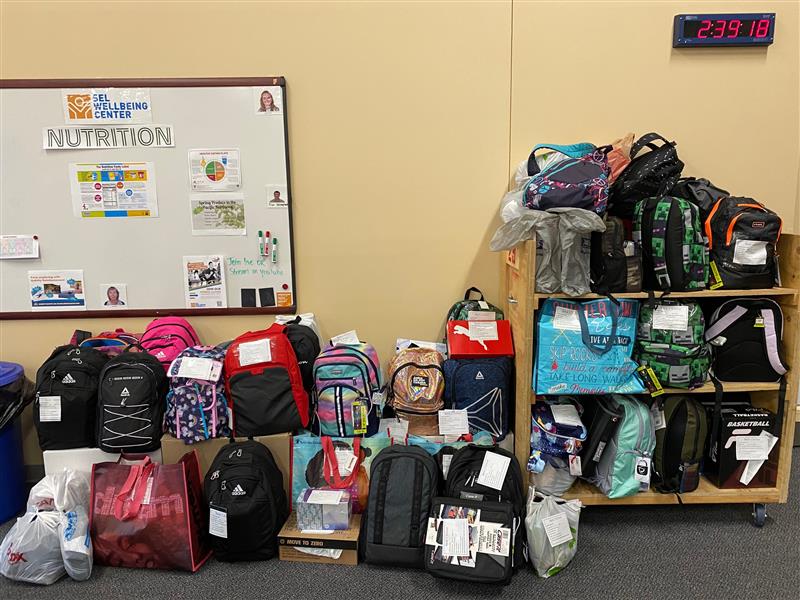
Homes of Hope and Fostering Idaho collaborate on two events: a fall fest, new as of 2025, and a yearly Christmas party.
The fall fest is meant to be fun for the kids: there are crafts, a bouncy house and free pumpkins for everyone. Held right next door to Homes of Hope, it’s also an educational opportunity for the parents, who get tours of the office and an introduction to the services Homes of Hope offers, according to Lipsinki.
Homes of Hope and Fostering Idaho also collaborate on a yearly Christmas party, put on at a local church in Lewiston, Lipsinki said. At the party, kids get gift cards, toys, clothes, crafts, food and more.
At the 2025 Christmas party, Homes of Hope gave new items to 114 kids.

Between all the programs, services and items that Homes of Hope offers, Allman said she estimated that Homes of Hope serves around 50 families and 100 to 200 kids per year.
Homes of Hope services families in eight counties spread across two regions in Washington and Idaho.
In Washington, it serves Whitman and Garfield counties. In Idaho, it serves Asotin, Latah, Clearwater, Lewis, Idaho and Nez Perce counties. It also serves the Nez Perce Tribe.
The office, located at 818 17th Ave. in Lewiston, is open Tuesday through Thursday from 10 a.m. to 3 p.m.
Running lean, dreaming big
Homes of Hope accomplishes its mission with a “pretty lean” budget, Allman said.
It mainly sustains itself through donations. While the organization occasionally gets grants from foundations, it isn’t often, Allman said, and it never receives funding from the government.
“We have to work within those parameters,” Allman said.
In a dream world, Allman said, Homes of Hope would have a dedicated building for the Hope Room rather than storing it in the basement that it currently shares with a Christian school. She also dreams of training more counselors in Trust-Based Relational Intervention, which is pretty costly, she said.
Homes of Hope started over 20 years ago, when a family from Clarkston, Washington, decided they wanted to start fostering, according to Allman.
As they started the process, they realized the huge need for cribs, beds, clothes and other supplies. Slowly, they built a network of foster families that collaborated to share supplies as needed.
In 2008, after the network had grown, Homes of Hope formally incorporated as a nonprofit.
Homes of Hope is a Christian nonprofit, Allman said, and employees and members of the board are required to sign a statement of faith. The organization will serve anyone, whether they’re Christian or not, Allman added.
Linda Wells, who worked as the executive director of Homes of Hope from 2020 to 2023, said she had never really worked in the foster care system before that job.
“What I did learn was how incredibly important for foster parents to be educated about what fostering really is,” Wells said. While the government wants people to foster, she said she doesn’t think it does a very good job of offering education and support about the nuances of foster care.
“Homes of Hope really fills a huge gap there, for fostering and the children,” Wells said.
FāVS News uses professional journalists and thoughtful commentary to explore faith, values and ethics. Support journalism like this by making a tax-deductible donation. FāVS is a 501(c)(3) nonp

