

Listen to the audio version of this article (generated by AI).
From billboards to bridge-building, Eastern Washington nonprofit challenges misinformation and rural divides
A grassroots effort aims to connect people with reliable information about policy changes affecting small towns while using faith communities to encourage dialogue across geographic and political divides.
By Emma Maple | FāVS News Reporter
In Eastern Washington, one small group of people has a big dream: to raise awareness about how federal policies are impacting people, especially healthcare impacts in small, rural towns.
“There’s a real disconnect in terms of information people are getting,” Shirley Grossman, one of the founders of Prosperity Eastern Washington, said. “That was heartbreaking to us.”
The nonprofit’s goal is to get accurate information to as many people as possible, particularly in rural areas. One of the main ways it has been doing that is through a billboard campaign.
At the height of the campaign, Prosperity Eastern Washington had 13 billboards running from Colville to Walla Walla, with sayings like “Congress forcing painful choices: medicine or food?” and “Inputs up – profits down. Who’s representing us?”
Billboards tell the future
About three weeks after the first set of billboards went up, including one near Ritzville that warned people about potential impending healthcare struggles, The Spokesman-Review confirmed that prediction with an article that announced more than 100 employees at Ritzville’s East Adams Rural Health Care were being laid off.
“None of the townspeople knew,” Grossman said, adding that Prosperity Eastern Washington knew the health organization was in trouble because they have a former rural healthcare auditor on their team.
“There’s a real lack of transparency going on,” Grossman said. “We kind of opened some doors [and] some minds,” with the billboards, she added.
Following the financial turmoil in Ritzville, the East Adams Rural Healthcare board voted to turn the hospital into a rural emergency hospital in hopes of keeping the doors open.
Other rural hospitals and healthcare systems are still struggling, however, and Prosperity Eastern Washington wants to draw attention to those issues.
Spreading the message online and in the mail
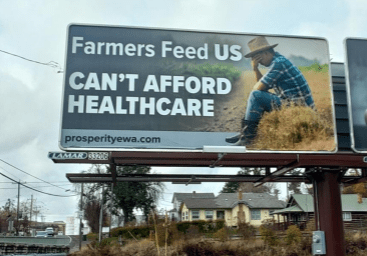
Due to cost concerns, the organization is transitioning from a billboard campaign to an online campaign utilizing social media, radio and streaming services, according to Pam Kohlmeier, a physician and attorney who is on the Prosperity Eastern Washington team.
The team is hoping people will hear the information and go to the Prosperity Eastern Washington website, which gives people more information about healthcare and other economic pressures brought about by federal policies.
Kohlmeier said the website sees about 1,000 views per month.
Prosperity Eastern Washington also has been sending postcards with healthcare information to rural towns and is hoping to connect with people in local communities to be ambassadors who can help spread accurate information.
“That, I think, will help this take off even more,” Kohlmeier said.
With sweeping cuts to Medicaid championed by the Trump administration’s 2025 One Big Beautiful Bill, Grossman said she thinks the need for accurate information is only going to grow.
“There’s such a lack of understanding of what is true, in those little towns,” Grossman said. “It’s really heartbreaking, it really is, because they don’t know and they’re all going to be hurt so badly.”
According to the Center on Budget and Policy Priorities, a progressive research and policy institute, the bill harms rural households by cutting healthcare coverage and food assistance in favor of finance tax cuts for wealthier individuals.
Rural hospitals would also be at a greater risk for closure, due to the loss of federal funding, the center wrote in June 2025.
Connecting faith communities across geographical divides
In addition to working with Prosperity Eastern Washington, Grossman had another, connected goal: to try and bridge the gap between rural and urban faith communities with sister-church partnerships.
“That’s where our hearts and minds have been,” Grossman said. “How do we blend these two groups of people in a way that satisfies the need that we have to understand each other, and not be critical, and not feel superior?”
However, she said she quickly ran into problems when she realized that connecting congregations that were separated by geography and culture would not be a slam dunk.
In fact, it didn’t seem to work at all.
“This is the story of a failure,” Grossman said. “This is not a triumphant story.”
The idea started when Grossman was contemplating how to break down barriers between people in urban environments and people in rural environments. According to the Pew Research Center in 2018, political and demographic differences between rural and urban communities continue to grow.
People seem to feel this divide, too. About two-thirds of people in both rural and urban communities said people from other communities don’t seem to understand the pressures their communities are facing. Additionally, a majority of people say that people who don’t live in their type of community, whether rural or urban, have a negative view of their community.
To break down those barriers, Grossman thought about partnering urban and rural churches that are part of the same denomination to “actually form bonds of friendship and bonds where you get to know each other.”
“They do not like us,” Grossman, who lives in Spokane, said about people in rural environments. “They think we’re just snotty and look down on them and don’t respect them, and there’s probably the same attitude toward people who live out in the so called ‘sticks.’ They think we’re uninformed, stupid.”
‘We all care about the same things’
Kohlmeier said partnerships between faith communities could break down those barriers because “faith communities are one space that people still trust.”
“In reality, we all care about the same things,” Kohlmeier said, adding that building bridges can help people realize others are “real people, like us, and they have these same shared concerns.”
Grossman began reaching out to rural and urban faith communities to gauge their interest in a sort of sister-church partnership built on a model of listening and learning from each other.
“It was an idea,” Grossman said. “Guess what? It didn’t work.”
Although churches and religious organizations that Grossman pitched the idea to said they were interested, many of them said they didn’t have the time to participate in the project. Grossman connected with other pastors who were trying to start similar initiatives, and in every situation, she saw failure.
Kohlmeier said she thinks many faith communities are struggling to do enough with the resources they currently have, and are overburdened just trying to focus on their own conversations. Grossman encountered the same thing — pastors she talked to said they loved the idea, but they were too busy to take part.
“It’s hard to be ready to do outreach, and kind of extend yourself as a bridge, when you’re really trying to stabilize at home,” Grossman said.
In the future, Kohlmeier said, rural-urban partnerships might be something that does work.
“The reality is, great ideas sometimes have to have the right timing,” Kohlmeier said. “Maybe, with the fact we are in a war right now, maybe now isn’t the right time.”
If the partnerships do materialize, Kohlmeier said she saw great things for the future.
“Once we do this, we will realize we have more in common, and we’ll stop demonizing each other,” she said.
FāVS News uses professional journalists and thoughtful commentary to explore faith, values and ethics. Support journalism like this by making a tax-deductible donation. FāVS is a 501(c)(3) nonprofit. © FāVS News. All rights reserved. Reproduction permitted only to authorized media partners or with written permission.

