

Listen to the audio version of this article (generated by AI).
The Muslim news you rarely see: How 20 million people come together in Iraq
The world’s largest gathering brings 20+ million people together in Iraq, revealing a powerful story of faith, generosity, community and the human spirit.
By Imran Haider | FāVS News Columnist
The views expressed in this opinion column are those of the author. They do not necessarily reflect the views of FāVS News.
About 10 years ago, I was teaching at a university in Oregon. I was teaching a perception lesson in my interpersonal communication class. At that time, I decided to conduct some unofficial research for the local and national news cycle.
I took a journey through all the main online news outlets at the time (ABC, CBS, NBC, FOX, CNN, BBC, etc.) and attempted to find one message: Is what makes news locally or nationally, typically negative or positive information? Or do news outlets typically attempt to provide threatening news to their audiences to increase viewers or readership?
Overwhelmingly, the answer was that our news cycle was dominated by news stories of crime, extreme weather and conflict. Even in sports, a scandal or mistake off the court or field would overtake headlines.
To take it one step further, I asked my students in all my classes at the time when was the last time they read a positive, feel-good community story out of the Middle East or Southern Asia. Not one of my over 100 students could recall any stories that highlighted positive community interaction or outstanding people.
Is there positive news in these regions?
Since then, I have thought about all the experiences I have had personally in Southern Asia and in the Middle East. I have several extended family members who live there, and I have heard many times about all the great ways they experience the positive power of the human spirit.
But these stories rarely make the news, especially on the western side of the world.
Would you believe me if I told you that one of the largest human gatherings in the world takes place in Iraq every year? Would you believe me if I told you that it yields participation of 20-25 million people? It’s called the Arba’in Pilgrimage, and it honors the martyrdom of the grandson of the Prophet Muhammad. It’s also:
- A 50-mile (80-kilometer) walk over the span of three to five days.
- A gathering that costs zero dollars to participate.
- An event in which over 20 million people participate.
Why do so many people participate?
Arba’in Pilgrimage is a religiously-motivated event on the Muslim lunar calendar that moves back about 10-11 days each year. However, anyone from any background is welcome. The significance of the walk is that it marks the 40th day of mourning of the grandson of Prophet Muhammad, Iman Hussein ibn Ali, who was martyred on the battlefield while staying true to the principles of Islam.
Many years ago, a powerful family had overtaken power and was attempting to change the way the religion was practiced. Hussein had a choice: either go along with the rule of a powerful, wealthy family or hold true to the original teachings. The spirit, belief and courage of Hussein was an act that inspired the religion for years to come.
How much does it cost?
The cost is free. You might wonder: Who is making money on this from necessities like food, water, clothing, shelter or health care? A community of people through this long journey of 50 miles sets up along the entire route as an act of charity and kindness. There are beds, meals and doctors providing care to anyone who needs it for the entire route.
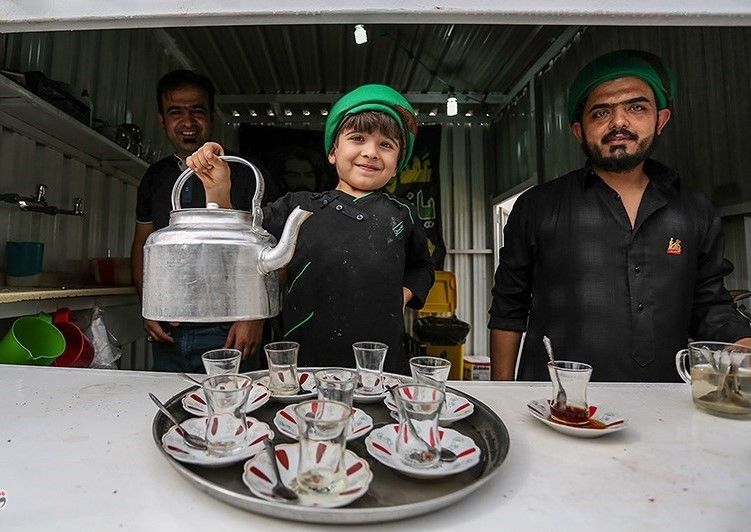
Just to reiterate, we are talking about the largest gathering of people in the world, with over 20 million attendees. We are talking about a gathering that is roughly 2.5 times the population of New York City. Coachella draws around 250,000 attendees each year, which is only about 80 times smaller.
It’s also a nonprofit event that showcases the intangible power of the human spirit. Enormous populations of people are participating and also volunteering to provide food, water, shelter and healthcare to others. Not once in my four decades of life has this been showcased on a news outlet as mentioned earlier in this article.
Religion(s) offer generosity, kindness, positivity, love, hope, structure and community to millions of people every day. I would love to see a future in our mainstream news media that highlights the beauty of our human spirit connecting with others.
Instead of only spotlighting religion when it has a negative impact, we should look at admiring the good it can bring everyday to so many communities.
FāVS News uses professional journalists and thoughtful commentary to explore faith, values and ethics. Support journalism like this by making a tax-deductible donation. FāVS is a 501(c)(3) nonprofit. © FāVS News. All rights reserved. Reproduction permitted only to authorized media partners or with written permission.

