

Think the Old Testament is outdated think again
Commentary by Mark Griswold | FāVS News
Discerning lessons from the Old Testament
There are some people today who disregard parts of the Old Testament, thinking it outdated and irrelevant. The thought goes that, for Christians, the New Testament is all that really counts, and the Old Testament is just some good background but not binding on our lives since Jesus came to give us a new law.
Yes, he did come to give us a new law, but it didn’t wipe out the old law. It fulfilled it. Yes, there were certain Old Testament laws that were applicable only to the ancient Hebrews in that time and place. Thankfully, for those of us who enjoy a good pulled pork sandwich, we aren’t bound by those anymore. But all of those laws, no matter how archaic they may seem to us, have some relevance on those of us living under the New Covenant. As St. Augustine stated, “The New is in the Old concealed and the Old is in the New revealed.”
Outdated laws for a barbaric people?
A lot of the Old Testament laws and stories seem ridiculous given the world we live in today. The best example is probably God ordering Abraham to sacrifice Isaac. Today we read that and think “what kind of nut would want to follow a God like that?”
But we need context. Genesis was written 3,500 years ago for a people in a wildly different culture. People of today judge others by the morality of today. In some ways, that’s a good thing. It means we have progressed in some ways as a world civilization. (We’ve also regressed in others.) But just as we don’t expect a toddler to have the same maturity as an adult, we shouldn’t expect a civilization in its infancy to be as mature as one 3,500 years on.
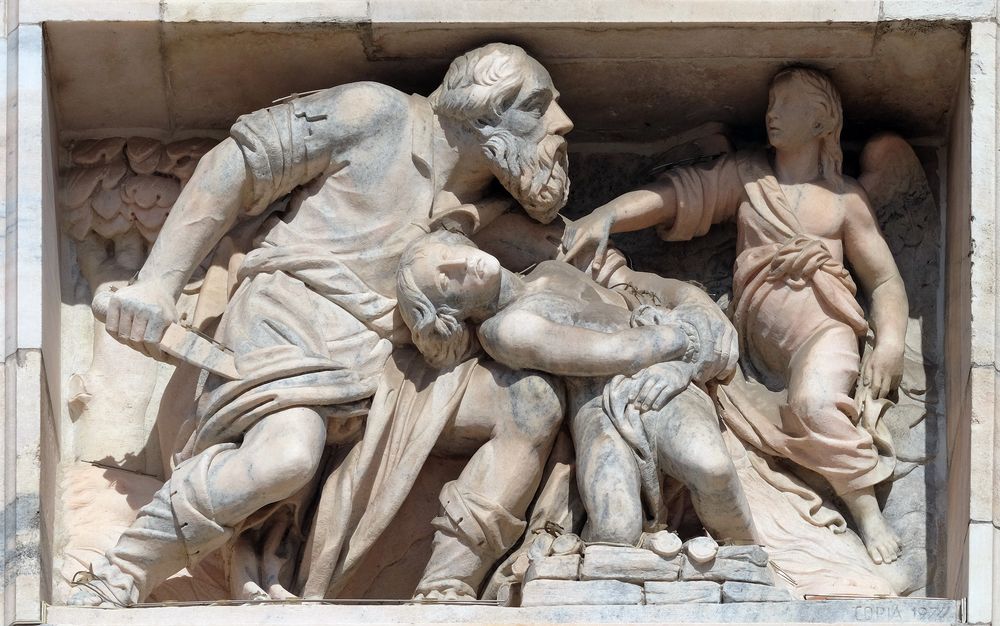
Back in Abe’s day, sacrificing children was standard practice. So was beating your slaves, slaughtering an entire village because someone stole your chicken and all sorts of other things we now look at aghast. The revolutionary thing about the God revealed to Abraham is that he said things needed to change in a direction of more equality and respect. If most people were sacrificing their children to their gods, it wasn’t crazy to ask Abraham to do the same. What was crazy, and showed the overwhelming love of God, was to tell him to stop.
It should also be remembered that Isaac wasn’t a captive but a willing participant. At the time, Abraham was a very old man. Sure, he lived longer than people do today, but he still would have been rather feeble. And Isaac wasn’t some pre-teen kid. He was likely in his mid- to late-teens and could have physically overpowered his father. He was likely also mentally mature enough that he had an idea of what was going on and was a willing, although probably fearful participant.
Some parallels to the New Testament sacrifice can also be found in this story. Abraham told Isaac that God himself would provide the sacrifice and so he did, finding a ram caught in a thicket at the time, and providing his own Son, Christ, 2,000 years later. It is also thought that the mountain on which Isaac was about to be sacrificed is the same mountain on which Christ was sacrificed. Finally, while Christ was a willing participant in his own sacrifice, being equally human, he also feared it to the point of sweating blood the night before.
Irrelevant details?
Some also wonder about the minute details and instructions outlined in Exodus and later books. Sure, they can be a slog to read through, but they show that God isn’t just a remote deity interested in the macro. (Or, as deists believe, a clockmaker who wound up the universe and let it go.) He also cares about the details of our lives.
It also shows, as above, that the Torah was written for a spiritually immature people who needed instruction in every little thing. When we’re teaching someone, especially a small child, a new task, we break it down to the ridiculous. We can’t just tell them to wash the dishes. We have to instruct them on what exactly that means. Or consider famed UCLA basketball coach John Wooden, who would begin each season with a lesson on how to put on socks and tie shoes.
We may brush past commandments against beating our slaves and think we’re so pious because we don’t even own slaves. (Never mind that much of slavery in the Bible was usually more akin to indentured servitude, and we still have many businesses today that treat their employees poorly.) We may skim the passages about the exact measurements of the tabernacle because we think it doesn’t have any relevance on our lives today.
Some of that may be true in the specifics. We don’t worship at a tabernacle in the middle of the Sinai desert anymore, and, hopefully, those of us who have employees treat them more like family than beasts of burden. But greater lessons can be taken from those stories. We can all treat each other more humanly.
Our planet and our crops might be better if we did more to practice crop rotation as commanded in Exodus instead of having industrial scale farming that seeks to leech out every last penny from the ground. (Not that some advancements in farming, including large scale methods, don’t have some benefit, but maybe there’s a happy medium.)
Maybe if we paid more attention to the small things, we’d be better at the greater things. Sure, God probably doesn’t care how our church buildings are laid out or whether we’re worshipping him in a grand cruciform cathedral or a small, converted supermarket, as long as we’re worshipping him. But it is interesting to think about how, when we start to compromise on the small things, the slightly larger things follow. Then, decades later our culture doesn’t in any way resemble what it started out as.
So we should read through all those boring bits of Leviticus. They have stood the test of time for thousands of years for a reason. If they seem irrelevant or outdated, perhaps we’re not digging deep enough into the text. What is God trying to tell us? What was the context in which it was originally written? What relevance does the text have on today’s culture?
If one truly believes that God is the Alpha and the Omega, omniscient and omnipresent, and if one truly believes that the whole Bible is his divinely inspired Word, it means that nothing surprises God, and that at the time it was written, he knew people would be reading it 3,500 years later and seeking wisdom in it. Either we submit to God’s will or we construct a god of our own design, which, for good reason, is the very first of the sins prohibited in the Ten Commandments.
The views expressed in this opinion column are those of the author. They do not necessarily reflect the views of FāVS News. FāVS News values diverse perspectives and thoughtful analysis on matters of faith and spirituality.


Thank you for this defense of aspects of Hebrew Scripture, especially the Torah. I would add that both the prophetic books and the wisdom books offer important and diverse perspectives still worth attending to.