

Guest commentary by Janine Warrington
The views expressed in this opinion column are those of the author. They do not necessarily reflect the views of FāVS News.
“Are we lost?” It’s what we were all wondering as our tour bus rolled through the Negev desert. Our 2017 Zags in Israel study abroad group was supposed to be visiting a Bedouin encampment, but we’d been rolling through a barren landscape for much longer than scheduled.
Everyone had to pee. “Where is the nearest bathroom?” we kept asking. Our bus driver assured us we could go when we arrived.
Bedouins are the indigenous peoples of the Negev Desert, a semi-nomadic group who have lived on and worked the land for generations. After the establishment of the state of Israel, the Israeli government created towns for the Bedouins to reside in to provide infrastructure and other services.
Some moved into these towns, but many, like our host, preferred to remain on their ancestral land in “unrecognized” villages. Since these villages lack official status with the government, they also lack resources such as electricity, water and sewage — something we were all about to learn firsthand.
We finally arrived at our host’s tent, a beautiful arrangement of dusty burgundy, olive and gold tatreez (“embroidery”) cloths. The inside of the tent was arranged with cushions on the floor for us to sit on as we spoke with our host.
But our first pressing question – where is the bathroom? Our Bedouin host pointed us to a thin juniper tree. Some in our group decided to hold it, but no way was I going to do that. I squatted under this tree in the middle of the desert as our host’s horse watched me.
Bedouins are Israeli citizens, but our host shared ways in which they are treated like second-class citizens. In 1948, many of these indigenous people were expelled from their land, and those who remained were confined to the Siyag, an enclosure of about 8% of the Negev.
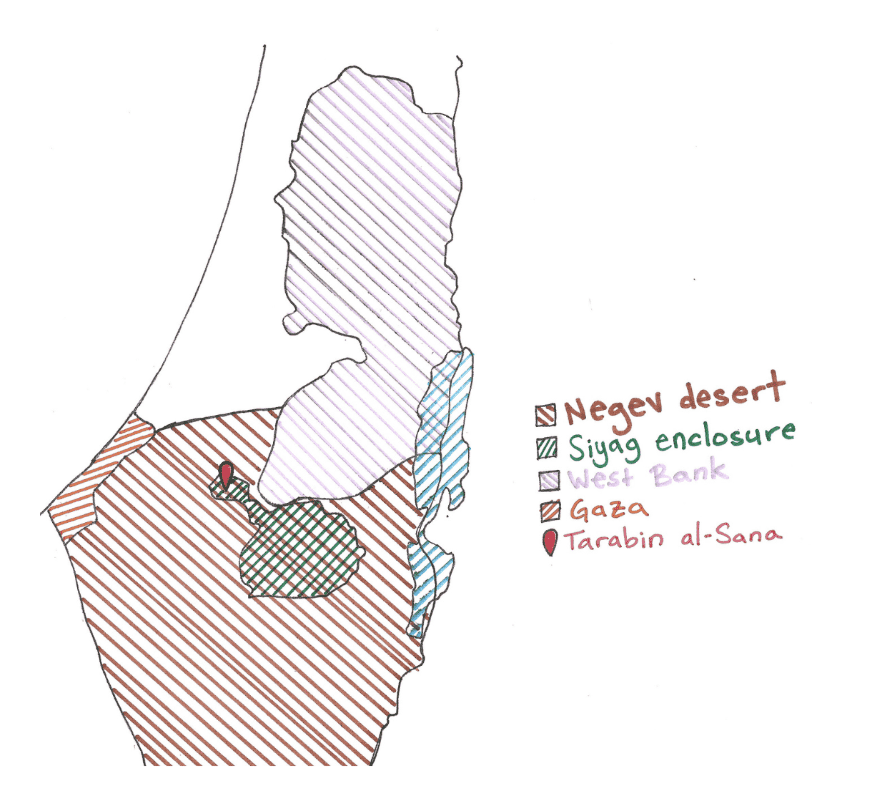
Disruptions and destructions of Bedouin villages, disregard for Bedouin culture, and lack of basic services fueled a clear anger in our host’s eyes.
On Oct. 7, 2023, seventeen Bedouins from the Negev were killed and six others were taken as hostages. Despite this, despite their claim to their ancestral land and despite their Israeli citizenship, Bedouins are still treated as less-than by their government. As native Arab Israeli citizens, Bedouins exist between cultures, caught in the middle of a violent clash.
On Jan. 4, 36-year-old Muhammad Hussein Tarabin was killed by Israeli police at his home in Tarabin al-Sana, a Bedouin village inside Israel. This was part of an Israeli operation to find and arrest arms smugglers in the Negev. Illustration by Janine Harrington / Contributed
Police officers and Minister of National Security Itamar Ben-Gvir have claimed that Muhammad was a threat to the officers, but Muhammad’s family says that the father of seven had not posed a threat and was not armed.
Our host toured us around his encampment, showing us his well and expressing fear of what would happen to him if his horse were ever injured. She was not only a juniper tree toilet voyeur, but a valuable investment, source of transportation, and part of the family.
Despite living in harsh conditions with so little, our host carried on a long Bedouin tradition of hospitality, much like his ancestor Abraham. Clashes in the Negev continue, with unclear and disputed details about perpetrators and victims. But even as these details are emerging, the fact remains that innocent people — many of whom, I remind you, are Israeli citizens — are being injured and killed.
FāVS News uses professional journalists and thoughtful commentary to explore faith, values and ethics. Support journalism like this by making a tax-deductible donation. FāVS is a 501(c)(3) nonprofit.


God gives humanity so many opportunities to do what is right and we continually fail. Why? because we trust self.
To trust humanity to do right is futile. Our faith must be in God to change our selfish heart, to let love grow, even in the face of evil.