

By Matthew Kincanon | FāVS News Reporter
Earlier this summer, Chris Parkin and LaRae Wiley (Sinixt), principal and executive director of Salish School of Spokane, respectively, traveled across the globe to Australia.
There they had the opportunity to offer training to Indigenous communities on their Salish fluency transfer system.
Not only that, they also found similarities between their histories, despite being worlds apart.
One summer in Montana
It all started in the summer of 2022 when the school put on its annual immersion symposium when, out of the blue, they got several registrations from Pertame School, a nonprofit in Alice Springs, Australia. The Pertame language has around 20 surviving fluent speakers, all of whom are elders. The nonprofit is a language nest that immerses children from birth to 5-years-old and their parents in their language.
Parkin said they were surprised that people from Alice Springs registered to travel to Rocky Boy’s Indian Reservation in Montana for the symposium. Later, they found out that the nonprofit found them through one of the Salish School’s partners in Oklahoma, the Yuchi Language Project.
“They did our two-day training for our summer immersion symposium and they loved it. They were really moved by the way we built, developed and shared our Indigenous language fluency transfer system,” Parkin said. “They went home, and they immediately made the level one language book and started using it.”
Parkin added the nonprofit started using their transfer system, getting great results with the parents of their language nest. The system is used to train new fluent teachers, parents and speakers, according to the Salish School’s website.
“Over that three-year period, we provided some training over Zoom in terms of implementation and development of our fluency transfer system, and they’ve gone on to develop the level one stories book as well in their language,” Parkin said. “They are now working on the level 2 language book.”
Then, in April last year, Parkin and Wiley connected with First Languages Australia, which works to revitalize the Indigenous languages of the continent. It was then that Parkin and Wiley were invited to the continent to hold a two-day workshop on their system.
In June of this year, Parkin, Wiley and their family got their tickets and made the journey to the opposite end of the world.
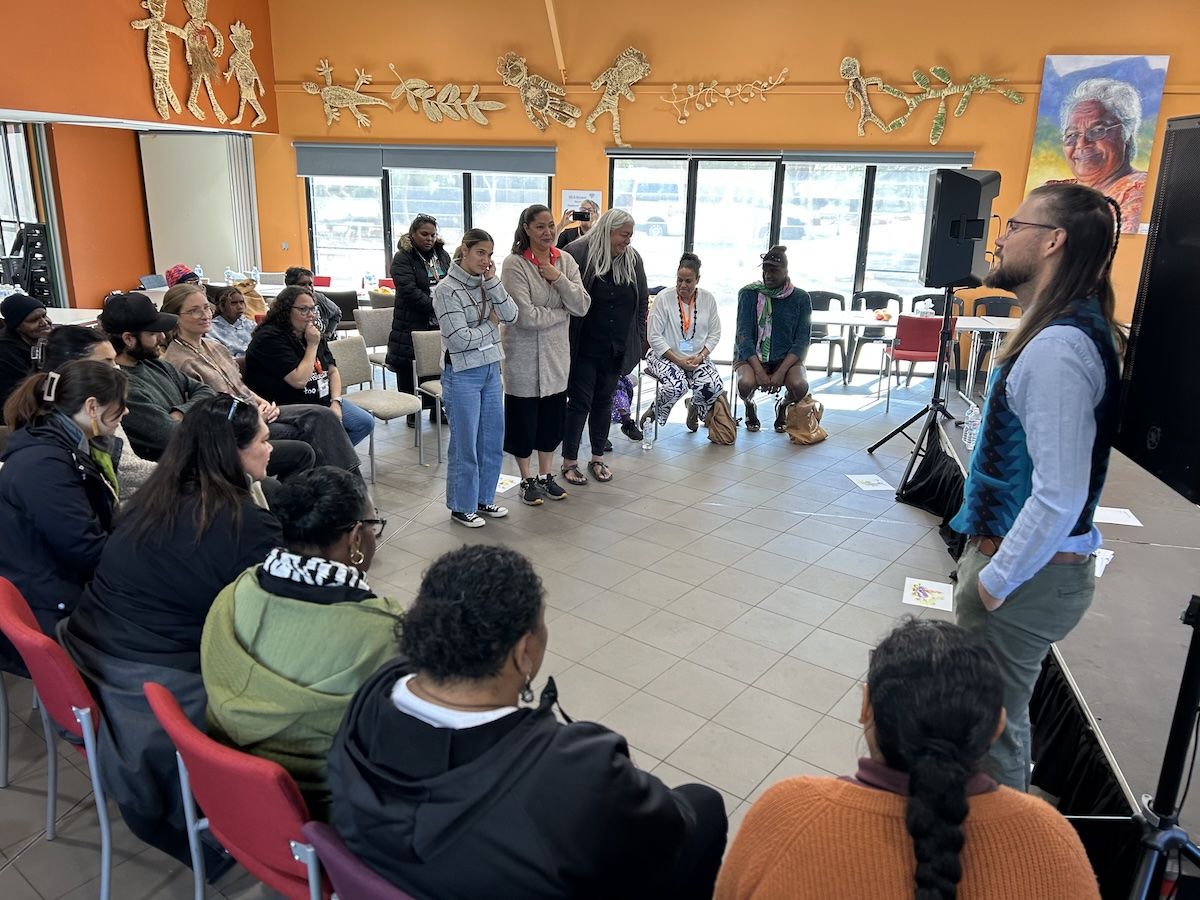
During the workshop in Alice Springs, around 47 Aboriginal and Torres Strait Islander language teams consisting of two people attended. The teams included a speaker of the language and a trainee.
The goal of the workshop, according to First Languages Australia’s website, was to “provide inspiration and skills to help our language communities to create and deliver the fluency transfer system in our languages and create new, advanced fluent speakers.”
In the training, Parkin said their son and lead elementary school teacher, Grahm Wiley-Camacho, told the story of how they became a three-generation fluent Salish-speaking family. He told the story in Salish, while his 12-year-old daughter translated it into English.
“Usually that gets the people right there because that’s what everybody is dreaming of,” Parkin said. “That their kids and grandkids would hold onto that heritage, have that language and that identity as part of their lives.”
Parkin then did a presentation of all the things he and Wiley learned as they tried to become fluent in Salish and shared it with other people. They described the challenges of revitalizing an endangered language mistakes they made, and those they encountered who helped them get on the right path.
The attendees then got to learn a full language immersion lesson so they could experience what it felt like to learn through it and be successful. On the afternoon of the first day, attendees were taught a lesson from the level one language book. On the second day, they were taught a mini-lesson from the level one stories book.
At the end of the lesson, they were able to tell the story in nsəlxčin (Colville-Okanagan Salish).
“Having them actually experience the immersion methodology that goes with the level one of our fluency transfer system really makes it stick, and they can really see how it works, how you can teach through immersion even for a critically-endangered Indigenous language,” Parkin said.
Salish System Finds Global Reach
Alice Springs wasn’t their only stop on the continent. Parkin and Wiley also visited a young Indigenous couple in Adelaide who are working through their nonprofit to revitalize Kaurna, a language that hasn’t been spoken on a daily basis since the late 1800s.
Jonathan Newchurch (Kaurna and Narungga heritage) and Natasha Martin (Te Arawa and Ngāti Ranginui), invited Parkin and Wiley to do a workshop with them last August. Even though Newchurch and Martin couldn’t attend the workshop in Alice Springs, Parkin and Wiley decided to do a two-day workshop on the transfer system with their group and family.
“They’re both medical doctors, and they have put that aside to do this language revitalization project while their daughter is young so that they can learn the language and she can learn the language and bring that language back from extinction,” Wiley said.
Even though the language hasn’t been spoken for over 100 years, Parkin said it was during the colonial period in the 1800s, German missionaries and linguists documented the language extensively, creating an archive with words, sentences and grammar that can be analyzed.
Because the language hasn’t had a fluent speaker for so long, Parkin was skeptical that their system could be used. However, that changed when he met Newchurch and Martin and saw their commitment as well as the quality of the language’s archive.
Parkin and Wiley said Newchurch and Martin’s commitment and work reinspired them in their own revitalization efforts.
A shared history of colonization and resilience
While in Australia, Parkin and Wiley heard peoples’ stories about loss of languages and the communities’ desires to bring them back.
One of the teachers who learned about the fluency transfer system took Parkin and Wiley to their aunty’s place and showed them some rock formations while teaching them how they cared for the land.
One thing people said to the Parkin and Wiley was they don’t feel alone after seeing what the Spokane school was doing.They felt they could go forward, make connections and do the transfer system. It’s a global struggle for justice.
Wiley noted the similarities between the struggles of language revitalization and health and wellness of both Indigenous people in the U.S. and Australia.
Like Indigenous people in North America, those in Australia also experienced boarding schools, discrimination as they tried to make space for their languages and other similarities that came with genocide.
“Everything that they’re facing are things that we face, and I think there is just a really clear effect of colonization and genocide on Indigenous people,” Wiley said. “It’s really a globalized thing that happens when people are colonized and their languages are stripped from them.”
Parkin also noted the coping strategies, resilience, strength and creativity of the Australian Indigenous communities were similar to what they experienced in their own Indigenous circles.
Despite the struggles and challenges they and their ancestors faced with racism and discrimination, Wiley said the Indigenous people of Australia are still there, strong and moving forward in saving their languages; all of which really spoke to her.
“We’re excited that we can take inspiration from them and hopefully we can provide some inspiration to them and some new partnerships,” Parkin said.
Parkin and Wiley said anyone can contribute to the revitalization effort by donating to the Salish School as well as the organizations in Australia.
Some people from the continent will be visiting Spokane to attend Salish School’s next immersion symposium and see its campus.



Awesome, story, of what is possible! SOOO inspiring on a true human level. Thank you for sharing out, Matthew.