

Prayer can motivate action by grieving community after loss of Idaho firefighters
Commentary by Mark Griswold | FāVS News Columnist
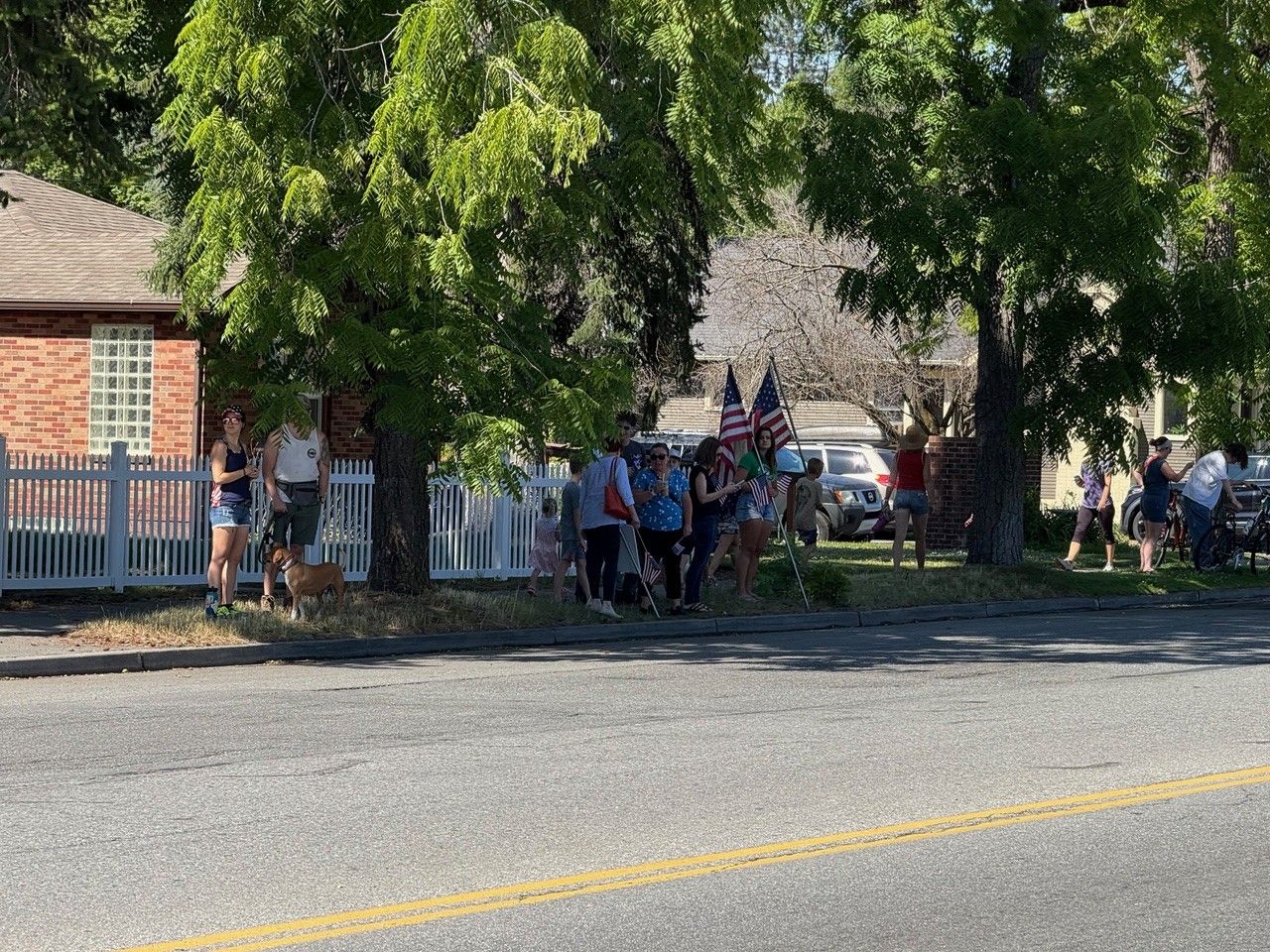
The people were lined up by the thousands, stretching from Spokane to Coeur d’Alene. Flags waived. Scouts stood at attention. A bugle sounded taps as a long procession of vehicles representing fire departments and law enforcement from around the region made its way down Sherman Avenue.
As the hearse carrying the two slain heroes passed by, the silence spoke volumes. We were here late morning and early afternoon Tuesday (July 1) in the wake of tragedy to honor those who’d paid the ultimate price.
Where I was when I found out
I first learned about Sunday’s (June 29) shooting how most of us seem to find out about most things these days — my Facebook feed — with a post calling on us to “PLEASE PRAY FOR LOCAL FIRE AND LAW ENFORCEMENT!”
Since that tragic moment, social media has been filled with calls for prayer and remembrance for those two brave firefighters who gave their lives. Within hours of the news, the community of Coeur d’Alene stepped into action, setting up aid stations near the scene and raising funds for the families of those who were shot.
Of course, some folks felt the need to be contrarian in this moment of tragedy, voicing their opinions that “prayer does nothing.” Since I’m a contrarian at heart, I can appreciate their view and welcome their voice in one of the most important, but usually overlooked, discussions in our society: the power of prayer. But I disagree.
There is power in prayer. Here’s why.
Some claim prayers are just words and thoughts, not actions. To some extent that is true. Actions are important. Before there is action, however, there must be thought.
Is the action we wish to elicit from prayer an action on God’s part though? Does God really answer prayers like a cosmic butler, doing whatever we ask? No. God is, was and forever shall be. He knew everything that was going to happen since before time began, including his own actions and answers to prayers.
So then, what is prayer for? Perhaps it serves to shape our own wills to align with God’s, not the other way around. As Abraham Lincoln said during the Civil War, “Sir, my concern is not whether God is on our side; my greatest concern is to be on God’s side, for God is always right.”
Some folks talk about manifesting reality with our thoughts. In other words, if you picture yourself getting that new job or meeting your future spouse, it will happen. That’s not exactly true. It’s more the case that those opportunities were out there but until you centered your mind on them, you were unable to see them and know how to respond.
Prayer centers us on God
Prayer, done right, centers the mind and soul on God. It allows one to see the opportunities God has laid out for us and informs us, through the Holy Spirit, as to what actions to take when those opportunities manifest. We’ve all reflected on events after the fact and thought about what we could have done differently. Prayer can be reflecting on events before they occur.
Far from prayer doing nothing, if everyone were to pray, the results could move mountains.
And what’s the alternative? Some people say “call your congressman” as if congressmen have more power than God.
Perhaps that’s the real problem with society. Too many of us worship the golden calf of Congress (or some other earthly power) instead of the Most High God.
But let’s indulge that line of thinking for a moment. Let’s say we call our congressmen, and they get together and pass a law that does such and such a thing. What then? Are the situations we seek to remedy done so by words on a page any more than they are by prayer? Aren’t the two things just words in different form except that one is delivered to the ears of God while the other is filed into oblivion?
In Federalist #61, Alexander Hamilton stated that “[i]t will be of little avail to the people, that the laws are made by men of their own choice, if the laws be so voluminous that they cannot be read, or so incoherent that they cannot be understood: if they be repealed or revised before they are promulged, or undergo such incessant changes, that no man who knows what the law is to-day, can guess what it will be to-morrow.”
The Law written on our hearts
We have the Law and the law is simple: “Love the Lord your God with all your heart, soul, and mind and love your neighbor as yourself.” If we were to pray, we’d see that it has been written on our hearts, and we’d need no other.
To quote another Founding Father James Madison, “[I]f men were angels, no government would be necessary.” So, then, we need more to guide us beyond that simple Golden Rule given by Christ. God the Father knows this and so delivered it to us upon stone tablets atop Mount Sinai.
Even if one is not a Jew or Christian, they can attest to the efficacy of at least some of those laws. Do not steal. Do not murder. Do not lie. (The remaining seven can perhaps better be thought of as laws of the heart than laws of action, but in many ways, they are more important for, again, actions must be born as thoughts.)
Let us pray
So let us pray. Although we don’t fully know the Coeur d’Alene shooter’s motives or background, we can almost certainly say that he came from a troubled background, perhaps abused by those around him during his childhood.
While the loss of firefighters’ lives is indeed tragic, and they and their families should absolutely be prayed over and supported in more tangible ways, just as our community is doing, we should also remember to pray for the man who carried out these evil actions.
During the Passover Seder, the Jews dip bitter herbs in saltwater. This symbolizes the tears of God shed not just for the hundreds of years of bondage that the Jews were escaping, but also the loss of life that happened when God closed the waters of the Red Sea over the pursuing Egyptian army.
This may seem strange, as it was God himself who brought about their destruction. But they were no less human, no less created in God’s image. Every person who commits a heinous act was once an innocent toddler.
So, when we pray for our “enemies,” while we can wish that their hearts will turn toward what is good, we can also see those prayers as a time to reflect on our own actions. How have we contributed to the suffering of others? Did we miss an opportunity to offer a kind word to a lonely soul before he turned down a path of evil? Did our harsh treatment of an impressionable youth cause them to turn toward the darkness?
Pray for grace in our time of need
Yes, everyone has a choice, and some of the greatest peacemakers, Christ chief amongst them, have faced hate with love. Let us pray for the strength of grace so that can we do the same. Let us pray that the change we see in the world can begin with us for the greatest battle is not outside ourselves but within. Only by conquering our own demons can we help others to conquer theirs.
Perhaps our prayers will not change the actions of others, but neither can words on a page. Let us pray, then, that our own thoughts and actions will be changed and fall in line with what is right and holy. The greatest battle is not outside ourselves but within. Once we master our own demons, only then can we seek to help others master theirs.
The views expressed in this opinion column are those of the author and do not necessarily reflect the views of FāVS News. FāVS News values diverse perspectives and thoughtful analysis on matters of faith and spirituality.



I’m so sorry for what happened in your community — it shouldn’t happen anywhere. I looked for a contact on your websites to offer a collaboration on something sometime — a believer and nonbeliever put their heads and hearts together thing. That sounds sappier than I wanted it to, but let me know if you’re interested.