

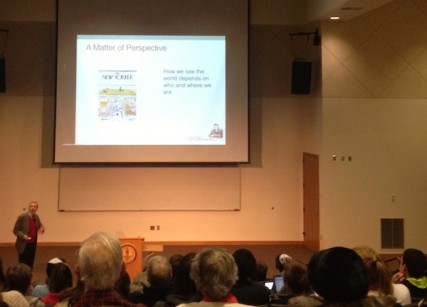
Whitworth University kicked off its annual Great Decisions lecture series on Thursday night by examining how Americans view the Muslim world.
Lawrence Pintak, former Middle East correspondent for CBS, and the founding dean of Washington State University’s Edward R. Murrow School of Communication, began his lecture by explaining the power — and danger — of perception.
“There is a perception that they are evil, they are hateful, they are violent,” he said. “We’ve heard the old headline ‘It’s policy, stupid.’ But it’s also perception, stupid.”
He said how people view one another is a product of their environment. That, he said, goes for both Arabs and Westerners.
“We Americans see ourselves as the city on the hill. It’s been a theme woven through American foreign policy, that we’re exceptional and bring that exceptional stuff to the rest of the world,” Pintak said.
He pointed to the statement President George W. Bush made on Sept. 11, 2001, “…we’re the brightest beacon for freedom and opportunity in the world.”
Pintak said Bush’s words are a reminder that Americans see the U.S. as bringing light — democracy and human rights — to the rest of the world, particularly the Arab world.
“There’s an essential disconnect between how we see our policy and how people in the Muslim world see us and our policy,” Pintak said. “This isn’t about misunderstandings, though there are lots of those. This isn’t about media bias, though there is an element of that. It’s about a fundamental disconnect in worldview.”
He said political leaders need to bear this in mind when making public statements about the Middle East.
In 2006, then Secretary of State Condoleezza Rice described the 2006 war in Lebanon as “birth pangs” of the Middle East.
In the Arab context, Pintak said, those words had a much different meaning.
He urged the students and community members attending the lecture to also keep in mind that the news they see and hear about the Middle East is produced through a Western lens for Westerners, though that may soon change with Al Jazeera America.
Al Jazeera America is a news channel expected to launch in the U.S. this year by the Qatar-based television network Al Jazeera.
Political Science Professor John Yoder said the 56th annual lecture series is designed to bring speakers to campus to discuss a variety of issues important to U.S. and American foreign policy.
The second Great Decisions lecture will take place at 7:30 p.m. on March 7, at 7:30 p.m. in Weyerhaeuser Hall’s Robinson Teaching Theatre. The speaker will be Richard Schatz who will present “Myanmar and Southeast Asia.”

