

By Lawrence Pintak | FāVS News Columnist
The classic Christian cross is a clear and powerful symbol. Whether hung above an altar or on the necklace of a believer, it represents faith in the divinity of Christ.
But change the dimensions of that cross, and the setting in which it is displayed, and the meaning can become far more ambiguous.
You need look no further than the chest of Trump’s Secretary of War to understand the association of the cross with white nationalism. Or see images from the recent anti-immigrant rallies in the UK, where it has become ubiquitous.
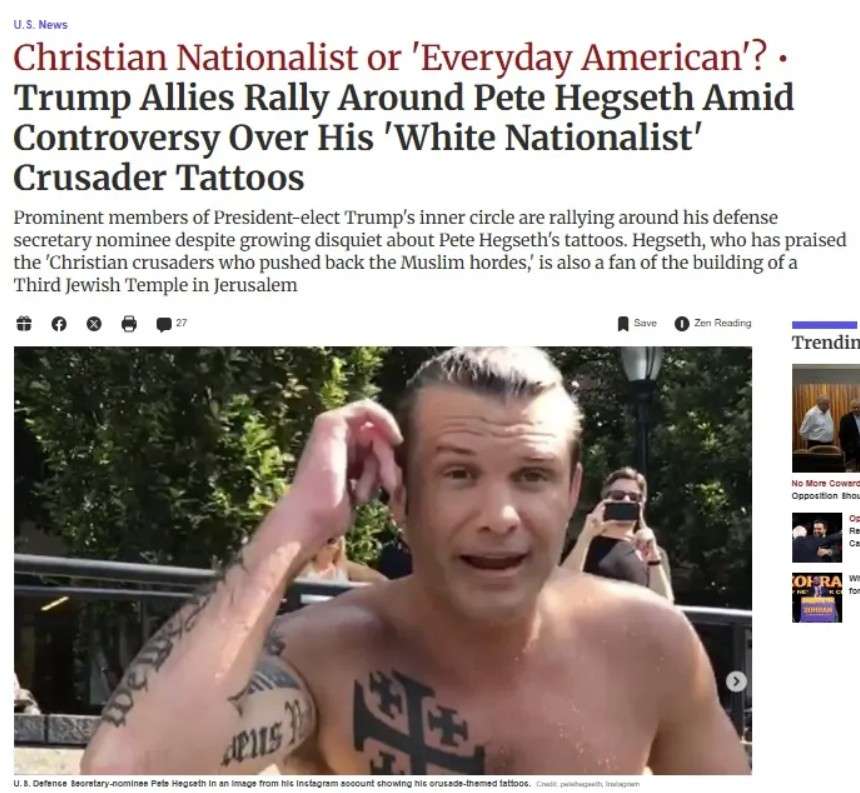
A huge St. George’s Cross dominates one side of Hegseth’s chest, not far from the Latin catchphrase “Deus Vult” — “God wills it” — which white supremacists erroneously believe was a Crusader war cry. The cross is becoming equally conspicuous wherever white nationalists tread in England.
The St. George’s Cross first came to prominence as a symbol of the Christian Crusade against Islam. It decorated shields, armor and the prows of ships in the belief that the martyred saint would protect their “righteous” cause.
St. George also happens to be the patron saint of the (somewhat fraying) United Kingdom. To a degree most outside the country don’t understand, “Great Britain” is an increasingly loose alliance of “nations.”
The St. George’s Cross in red on a white background is the national flag of England (Scotland and Wales have their own flags). It drapes the stands when the English football (soccer) team plays rivals and is joyously waved by children at the annual St. George’s Day parades. The prime minister has one in his flat at Downing Street.
In the Union Jack, the banner of the United Kingdom, the St. George’s Cross merges with the white diagonal of St. Andrew — on Scotland’s Saltire flag — with the red diagonal cross of St. Patrick — representing Ireland — to signify the supposed unity of the British Isles.
Flags have long been avatars for ethno-national pride among the “nations” that make up the UK. Here in Scotland, where I live at the moment, you see few Union Jacks. Most flags are the blue and white Scottish St. Andrew’s Saltire, reflecting the fact that half the population wants to secede from the UK.
In Wales, you see the Red Dragon flag, said to be the banner of King Arthur. In Northern Ireland, Protestants who want to remain in the United Kingdom fly the Union Jack while Catholics who want independence from Britain fly the Irish Tricolor, the national flag of the Irish Republic.
That said, it’s usually only at football games or national holidays that you see those national flags lining streets or decorating front lawns.
Now that has changed. And just as the American flag is being co-opted by the political right in the U.S., the St. George’s flag has been seized on as the war banner of Britain’s wanna be crusaders on the anti-immigrant right, from whose ranks we can also hear Hegseth’s beloved cry, “Deus Vult.”
In the past couple of months, sales of St. George’s Cross flags have skyrocketed as the streets of some towns and cities have been lined with the vivid red cross, and the flag blankets mass rallies demanding that the government “turn ‘em back,” referring to immigrants. As with Trump supporters in the U.S., the political right has also taken up the UK national flag, the Union Jack, as a totem.
It is now becoming increasingly difficult to determine where classic patriotism ends and xenophobia begins.
A long time coming.
The controversy isn’t completely new. Back in 2018, under the headline “Is flying a St. George’s flag an act of patriotism or a symbol of all that is bad about England?” a columnist in The Independent wrote:
“The Union Jack and the St. George Cross have been tainted by association with the far right. Nobody seems surprised any more to see some bull-headed idiot draped in the flag and performing a Nazi salute. Which is a quite remarkable state of affairs.”
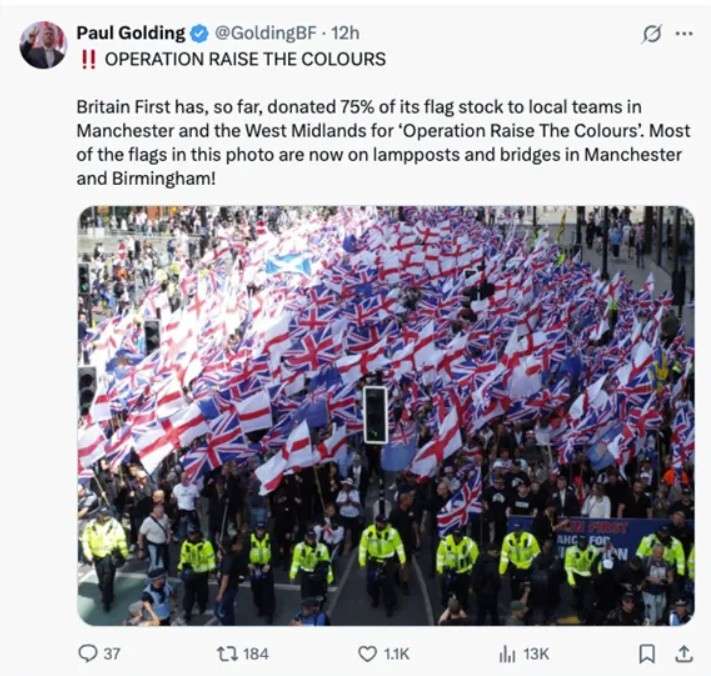
The difference now is the scale. And the organized nature of what is clearly not some grassroots movement. In one section of the city of Birmingham over the summer, more than a thousand St. George’s Cross flags appeared on lamp poles lining the city’s streets as part of a national “Operation Raise the Colours.”
Residents proudly said it was a reflection of their national pride. Others are not so sure.
Politicians always walk a fine line when it comes to people displaying national symbols. The sudden flag phenomenon is no different.
Back in the summer, Prime Minister Sir Kier Starmer publicly backed the right of local councils to display the flag, but after the Union Jack and St. George’s flags became props at a mass anti-immigrant rally organized by the far right, Starmer told reporters he intended to “reclaim” the flag: “Britain will not surrender its flag to those that wish to use it as a symbol of violence.”
The Crusade as political narrative. The cross as totem designed to provoke, anger and alienate.
The conservative Daily Mail dubbed those behind the movement “an army of patriots,” but as other sectors of the media dug into the story, they began to find the fingerprints of anti-immigrant extremists.
“Far-right link taints ‘patriotic’ grassroots flag movement,” read a recent headline in The Times.
They didn’t have to dig very deep. An anti-immigrant activist who calls himself “Andy Saxon” – as in white Anglo-Saxons — publicly declared himself a leader of the flag movement, and Paul Golding, the head of the far-right Britain First political party — which has been described as a neo-fascist hate group — proudly announced on social media that it was donating flag stock to the cause.
Ties between Britain’s would-be crusaders and those across the Atlantic run deep; they are political, financial and cultural. “Nigel is a cult figure on the right here,” Steve Bannon, the éminence grise behind Trump’s 2016 victory, told Irish journalist Peter Geoghegan, referring to Nigel Farage, leader of the ultra-conservative Reform UK political party, which is quickly gaining traction.
“Americans claim Brits are oppressed as they wade into St. George’s flag row,” the Daily Mail gleefully reported.
The conservative media in the UK also seized on comments from U.S. Vice President JD Vance. “We should push back against the crazies who say we should be so ashamed of our culture and of our heritage that we shouldn’t be willing to fly a flag. It’s craziness,” he told Fox News. “We got to call that craziness out. I’d encourage our European friends to follow suit.”
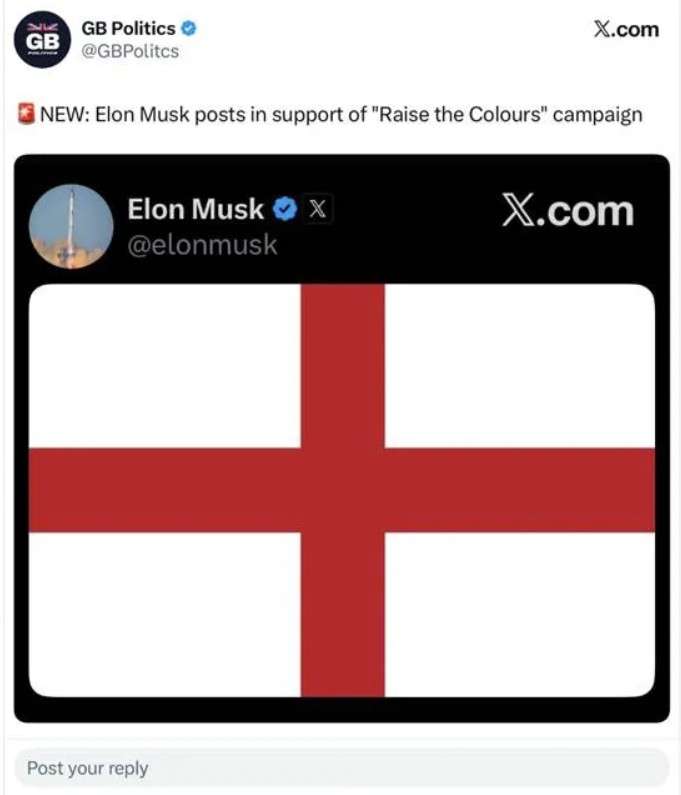
Even Elon Musk weighed in. “Violence is coming,” he told one London anti-immigration rally via satellite. “You either fight back or you die.”
Pope Urban II, who commissioned the first Crusade, couldn’t have said it better.
Where’s my helmet?
The Crusade is a powerful and enduring theme. In modern politics, it is a tool to rile up the masses, as when President George W. Bush declared a “crusade” against terrorism after 9/11.
It’s also a toxic form of cosplay by those who have convinced themselves they have been victimized by society; an overt f*** you to the imagined “other.”
That was on display in Gaza this year, where the private army deployed to protect the Trump Administration’s (paltry) aid distributions included members of an anti-Muslim motorcycle gang called the Infidels, who wore vests embroidered with the Crusader’s cross. One member of this “security team” posted a photo of himself in Gaza shirtless, displaying an array of crusader-themed tattoos.
“Putting the Infidels biker club in charge of delivering humanitarian aid in Gaza is like putting the KKK in charge of delivering humanitarian aid in Sudan,” the Council on American-Islamic Relations complained.
But that’s kind of the point: The Crusade as political narrative. The cross as totem designed to provoke, anger and alienate. It has little to do with the values most Christians would associate with the cross hanging over the altar in their church.
After attending a London anti-immigrant rally that drew more than 100,000 people, a writer for the leading British Christian magazine reported, “This wasn’t a vision of ‘Come one, come all,’ the title of the Christian authored official theme tune for a rally meant to ‘Unite the Kingdom.’ A better song title might have been, ‘Come one, come all, come ready for a fight.’”
He was hoping to learn more about their “Christian values,” but before he had the chance he was punched and chased from the crowd.
War of the flags
Flipping the plot on the would-be crusaders, in the last month flags have begun appearing in Glasgow that combine the Scottish Saltire with the Palestinian flag. Organizers say it’s their response to the right’s hijacking of national symbols for its anti-immigration crusade.
“At a time of genocide and displacement, we want to show that compassion, dignity, and solidarity are stronger than borders,” the organizers wrote in a social media fundraising post.
In some ways, this new banner is an extension of another war of flags that broke out in Northern Ireland in the early days of the Gaza War. When I visited Londonderry — or Derry as the Catholics call it — back then, I was struck to find Israeli flags flying over Protestant villages on the approaches to the city, and the Palestinian flag in Catholic areas.
The Palestinian tie to the Catholics stretches back to the Palestinian Liberation Organization’s material support for the IRA during the “Troubles.” In response, Protestants have adopted the Israeli flag because they draw parallels between their own situation and that of the Israelis.
“Flags absorb meaning from the people who carry them,” writes Nick Spencer, a researcher on religion and society at the British Theos think tank, who opposes the use of the St. George’s Cross flag by the anti-immigrant right.
“May the St. George’s Cross stand not for hostility to those with a ‘different’ religion or skin colour, but for a welcome to those who are tired, broken, alone, in pain.”
Admirable sentiment. Perhaps they should start by breaking the news to the anti-immigration thugs: the Crusaders lost.
The views expressed in this opinion column are those of the author. They do not necessarily reflect the views of FāVS News. FāVS News values diverse perspectives and thoughtful analysis on matters of faith and spirituality.
Never miss a story. Get the top headlines, breaking news, commentaries, and handpicked favorites delivered straight to your inbox every morning. Subscribe to our quick, free and informative FāVS News Daily Newsletter.


It boggles my mind! I also can’t understand the anti-antifa going on. It’s like we’ve departed the Enlightenment and going Dark Age and devolving. Great column!
Enlightenment gave us the French Revolution and the Guillotine and that is where we are headed again.
No one wants dialog. We just have labels for both sides. If I give you a label, then I know what you believe and I don’t need to dialog. And the label is what “others” label you with and it sticks regardless of what you say.
This starts in grade school and even earlier. If you say you like something, even when it’s stated by someone you don’t know but has been labeled opposite of what you believe, that is now your label. If you make friends with the new kid but they turn out “bad”, you are now bad.
And what do the labels do? Ask any black kid, immigrant, disabled what labels do to and for them. It puts them in a hole that few can crawl out of. OR it can entitle them.