

By Caleb McGever | FāVS News Reporter
Nearly 300 community members gathered in St. John’s Cathedral in Spokane on Friday to pray for ICE protesters in Minneapolis — and for the Spokane clergy who traveled there to join them.
The handful of Spokane clergy who traveled to Minneapolis joined hundreds of clergy from around the United States for a gathering, which was organized by MARCH, an interfaith group in the Twin Cities.
Both events came together in less than a week, drawing faith communities to stand in solidarity with immigrant communities facing ICE enforcement.
Spokane faith leaders go to Minneapolis
The Rev. Mindy Smith, an ordained Presbyterian minister in Spokane, said she and several other Spokane faith leaders received MARCH’s invitations to Minneapolis last Saturday.
Smith said when she saw the invitation, “I just couldn’t say no to it.”
“I felt like this was an opportunity for me to go and bear witness, to care for those on the ground, to learn as much as we can, in hopes that we can continue to mobilize God’s people to go shine God’s light in the world,” Smith said.
Spokane clergy and faith leaders who planned to accept the invitation started connecting with each other and eventually created a plan to travel together, stay together and debrief together.
Smith said their group included 10 faith leaders in total, representing Presbyterians, Episcopalians, Catholics and Evangelical Covenant Church.
The group traveled to Minneapolis a few days early and rented an Airbnb in the area. During their stay, they hosted dinners for local agencies like Urban Village, which works with Karen and Karenni youth in St. Paul.
Smith said that during these dinners, nonprofit directors shared “a lot of tears, a lot of sadness, and a lot of exhaustion.”
One of her takeaways was the importance of being proactive and hyperlocal.
“The main reason that we came early was not only for care and for solidarity and to bear witness to what’s happening here, but also to learn as much as we can and to bring these things back home and mobilize in Spokane when it becomes needed. And it already is needed,” Smith said.
Walking the freezing streets of Minneapolis
MARCH’s gathering took place on Jan. 22 and led into the “ICE Out Now” protest the following day. Smith said MARCH’s event focused on training and practicing newly-learned skills.
The invitation sent to clergy advertised a day of “witness and resistance.” The focus of the event was “accountability to impacted communities” and building “relationships, skills and commitments needed for sustained action across the country.”
Clergy spent the day in neighborhoods frequently visited by ICE. There, walking around in their clerical garb, they watched for ICE and talked with locals.
“It was powerful to feel as if our bodies were somehow representing peace,” Smith said.
Smith recalled one pastor’s reflection to the group later that day: “I cannot even describe to you the repair that is coming to my soul by standing here and seeing you all here.”
“It gave us all a deep hope for the church,” Smith said.
Multiple faiths unite at St. John’s Cathedral
Meanwhile in Spokane, leaders of multiple faiths held a vigil for those in Minneapolis, including the Spokane clergy attending.
Petra Hoy, one of the Spokane event’s organizers, said the “Vigil for Minneapolis” at St. John’s was organized in merely 48 hours. It took place on Friday, the same day as the “ICE Out Now” protest in Minneapolis.
The event featured local faith leaders Dean Heather VanDeventer of St. John Episcopal Cathedral, the Revs., Jim and Andy CastroLang, Sister Susan Wells of the Roman Catholic Sisters of the Holy Names of Jesus and Mary, Rabbi Tamar Malino of Temple Beth Shalom, Karen Stromgren and Naghmana Shirazi from Muslims for Community Action and Support, Jenny Slagle from the Yakima Nation and the Rev. Ian McPherson from Salem Lutheran Church.
During the vigil, leaders offered words, prayers and songs. The names of the clergy who traveled to Minneapolis were read aloud. Andy CastroLang led the attendees through the Washington Immigrant Solidarity Network’s guidelines for witnessing ICE activity.
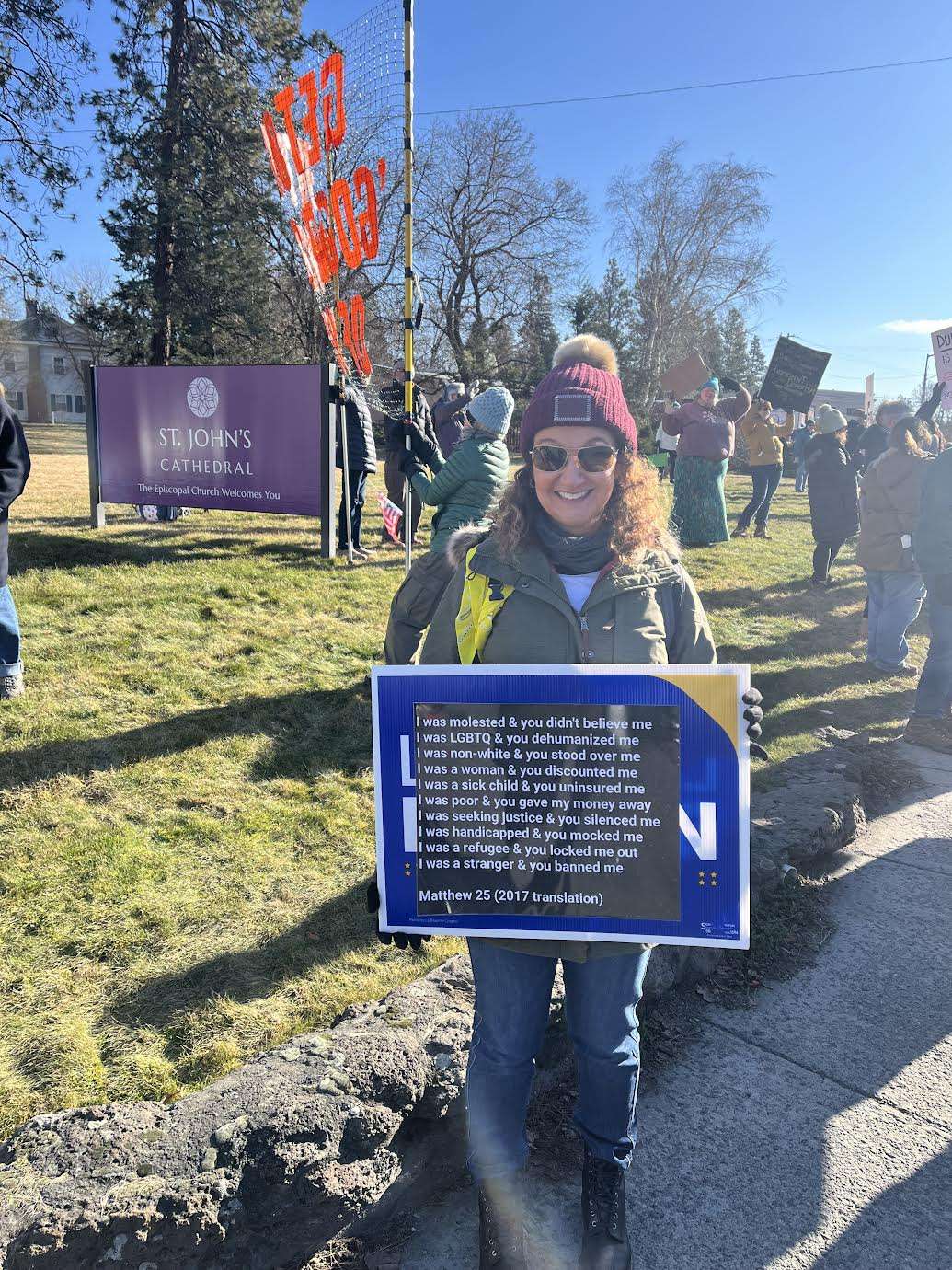
After the vigil, attendees walked outside to wave signs together.
Jim CastroLang, who also helped organize the event, said it was structured in two “acts.” The first act was the prayer vigil inside the Cathedral, and the second act was sign waving on the streets.
Beginning with prayer is meant to “get both feet on the ground, center yourself,” to ensure that taking action out in the streets “doesn’t push us into hate, doesn’t push us into violence,” Jim CastroLang said.
“Because from a faith point of view, we act out of hope, we act out of love. We act for justice, and if we get pulled into the anger that leads us into hate, rather than the anger that’s motivated by love, then it’s counterproductive and destructive,” he explained.
Tom Topping, who said he had attended protests in the past and had thought the vigil at the church sounded interesting, said he left the vigil feeling encouraged.
“I was just so touched to find out about all the faith leaders that are going to Minnesota and putting their bodies in between people and ICE,” Topping said. “I feel a little bit encouraged by it.”

