

By Matthew Kincanon | FāVS News Reporter
On Tuesday evening, the Spokane County Bar Association (SCBA) held its annual “Courage, Then and Now” event at Gonzaga University’s Hemmingson Center, recognizing the school’s law students who received the Carl Maxey Scholarship while discussing the importance of rule of law and leveling the playing field for legal professionals.
Maxey’s legacy

According to the SCBA website, the scholarship is an annual award that is given to GU law students who intend to further the goals of diversity within Spokane’s legal community by ensuring equal opportunity and inclusion for Spokane attorneys regardless of race, color, religion, national origin, gender, sexual orientation, age and disability.
Carl Maxey was the first African American attorney in Spokane and attended Gonzaga Law School. His work eventually led him to being recognized as a civil rights leader.
Associate Professor of Urban Planning at Eastern Washington University Margo Hill-Ferguson of the Spokane Tribe was the keynote speaker. She said Maxey not only broke barriers, he also exposed the ones against African Americans and Native Americans.
She recently learned that Maxey represented her great-grandmother, Sadie Boyd, in 1969 when banks and attorneys were taking advantage of her and her grandchildren.
“He fought for justice and understood that access to the law is a source of power,” she said.
Upholding the rule of law
After the Black National Anthem was sung by Alethea Dumas, Francis Adewale, Washington State Bar Association (WSBA) president, took the stage to present his speech.
During it, he described one section of the Rules of Professional Conduct (RPC) where one of the most important duties of a legal professional is to further the public’s understanding of and confidence in the rule of law and the justice system.
“Because legal institutions in a constitutional democracy depend on popular participation and support to maintain their authority,” he quoted.
He said this section is why the WSBA created the Rule of Law Ambassador Program to help legal professionals fulfill that obligation. He added that there is a deep and growing crisis of polarization in the U.S., which is “leading to the erosion of trust and confidence in our basic democratic foundations.”
He quoted a December 2024 Gallup poll where a record-low 35% of Americans had confidence in the judicial system. Confidence in the justice system, he said, is a responsibility they all bear as guardians in the temple of justice.
“We need the rule of law, rather than the rule of violence, now more than ever,” he said, adding that his home country of Nigeria was a place where the rule of law was nonexistent.
He described how legal professionals in Washington state should be united and care, regardless of their political views.
“The rule of law must be upheld,” he said. “And the rule of law means that the same laws apply to everyone.”
Near the end of his speech, he said he wanted attendees to leave inspired and prepared to speak up and not be afraid to do so.
Leveling the playing field
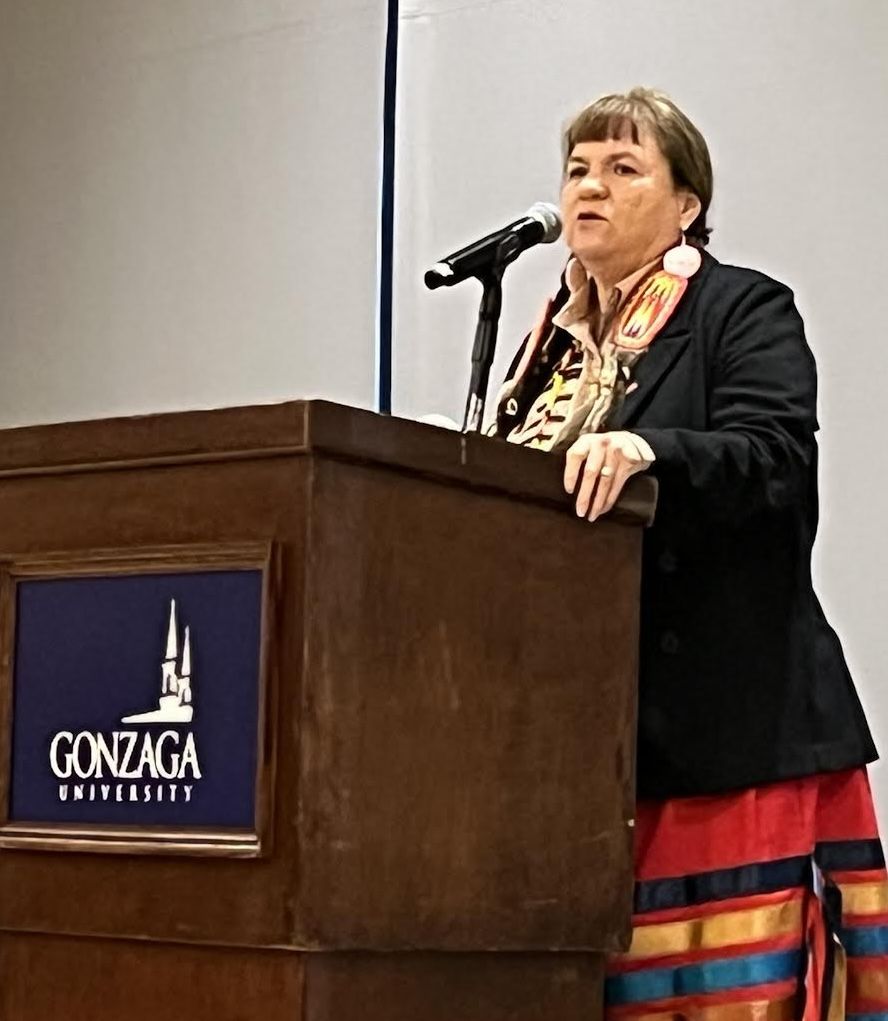
During her speech, Hill-Ferguson described barriers people of color faced in Spokane including how, in the 1950s, African Americans and Native Americans were denied housing. When her grandmother bought a home and was moving in, the neighbors called the owner and the sale was cancelled. She added how in those days, Native women could only be two things: maids or waitresses. This included her grandmother who was a waitress at the Davenport Hotel.
“Today, we are attorneys and judges,” she said. “As a Native female attorney who grew up on the Spokane Indian Reservation, I can tell you about the challenges. People don’t expect you to pass the Bar and to be in courtrooms. I was the first from the Spokane Tribe to graduate from law school.”
She described how the bar exam has served as a gatekeeper and as a test of endurance, financial stability and resources. The recently-awarded scholarships level the playing field, she said, adding that the recipients belong in the legal profession.
Part of her speech was dedicated to recognizing the three recipients of the scholarship, who were later brought on stage.

Monika Eckhart, one of the recipients, is a single mother who Hill-Ferguson described as being motivated by a passion to advocate for Head Start and early learning so children could have a better chance at a better life. Eckhart was also part of the Native Outreach and Advocacy Project at the Unemployment Law Project.
Ysabella Roberts, another recipient, is an African American, Puerto Rican and Mexican individual who has represented injured workers facing barriers. She is also the first person in her family to get a college degree.
Isaiah Waters, the last recipient, is an African American who worked for non-profits advocating for campus safety. He will specialize in health law to reform and protect rights in the American healthcare system.
The scholarship is a gateway
What excited Roberts the most was the fact the scholarship gave her the ability to take the bar exam.
“It’s a complete separate cost from law school,” she said. “Not something your financial aid applies to so it’s all out of pocket. Receiving this not only takes the weight off my chest but also allows me to actually take the Bar.”
She added that she has supported herself since she was 16, and the costs of the exam would have come out of her housing expenses. Staying at a hotel for the exam would cost her around $1,000.
For future recipients of the scholarship, she wanted them to know they will never succeed if they don’t understand they might fail.
“You keep going until you fail, but until then you don’t know you’re going to fail,” she said, adding that she had seen the fear of failing stop many people. “If you already got the scholarship, understand that this is a gateway and an opportunity and don’t let anybody tell you that you can fail.”
Donations to the scholarship can be made here.
FāVS News uses professional journalists and thoughtful commentary to explore faith, values and ethics. Support journalism like this by making a tax-deductible donation. FāVS is a 501(c)(3) nonprofit.

