

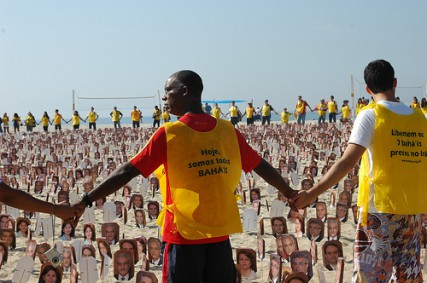
Religious believers throughout the world face a rising tide of restrictions, according to a study released Thursday (Sept. 20).
In the one-year period ending in mid-2010, 75 percent of the world’s population lived in a nation with high or very high restrictions on religious beliefs or practices, according to the study conducted by the Pew Forum on Religion & Public Life. Pew tracked religious freedoms denied by government and cultural authorities.
A previous Pew study on the subject found that 70 percent of the world lived under religious restrictions.
The increasingly hostile climate doesn’t come as a surprise to John Pinna, director of government relations for the American Islamic Congress.
“As countries, particularly developing nations, search for stability, religious persecution is a tool for consolidation of authority,” Pinna said. “Furthermore, in the developing world, governments lack the capacity to protect vulnerable populations from non-state actors who have their own political agendas.”
The Pew researchers found increasing intolerance in every region of the world. Government and social restrictions on religious freedom particularly tightened in the Middle East-North Africa region, Europe and sub-Saharan Africa, according to the study.
The Middle East and North Africa showed the highest levels of social and government hostility involving religion well before the beginning of the tumultuous period known as Arab Spring swept across the region.
Globally, restrictions increased not only in countries that already afforded few protections for religious freedom, such as Nigeria and Indonesia, but also in countries where citizens have generally enjoyed a high degree of religious liberty, such as Switzerland and the U.S., the study found.
Among incidents cited in the U.S.: the intense opposition to the building of a mosque in Murfreesboro, Tenn., and a spike in the number of religion-related workplace discrimination complaints.
The study covered 197 countries and relied on 19 sources of information, including the U.S. State Department’s annual reports on religious freedom.

