

By Caleb McGever | FāVS News Reporter
Community members met with the Spokane Alliance outside Spokane’s city hall on Monday to discuss an ordinance establishing new agreements and rules for the city’s public infrastructure spending.
Several clergy in Spokane spoke at the event, explaining how their spiritual roles led them to advocate for economic reform.
How pastors come to endorse economic reform
Evangelical Lutheran Church in America (ELCA) pastor, the Rev. Emily Kuenker, grounded her support for the ordinance to her experience as a Christian minister.
“As a campus pastor, I was prepared to lead Bible study and provide pastoral care. The reality is, I spend more time than I ever expected coordinating housing assistance, working with food banks and providing referrals,” she said. “Faced with these economic challenges, our young adults need opportunities that create financial stability.”
The Rev. Bob Feeny from Westminster Congregational United Church of Christ (UCC) said he came from a tradition “that believes that the world we imagine is possible, if we are willing to work together to build it.”
Feeny explained that he supported the proposed community workforce agreement because it would provide support to everyone, especially underserved communities in Spokane. He emphasized his hopes in the agreement’s ability to provide support to everybody — that instead of just some winning, it would allow everyone to win together.
How the ordinance works
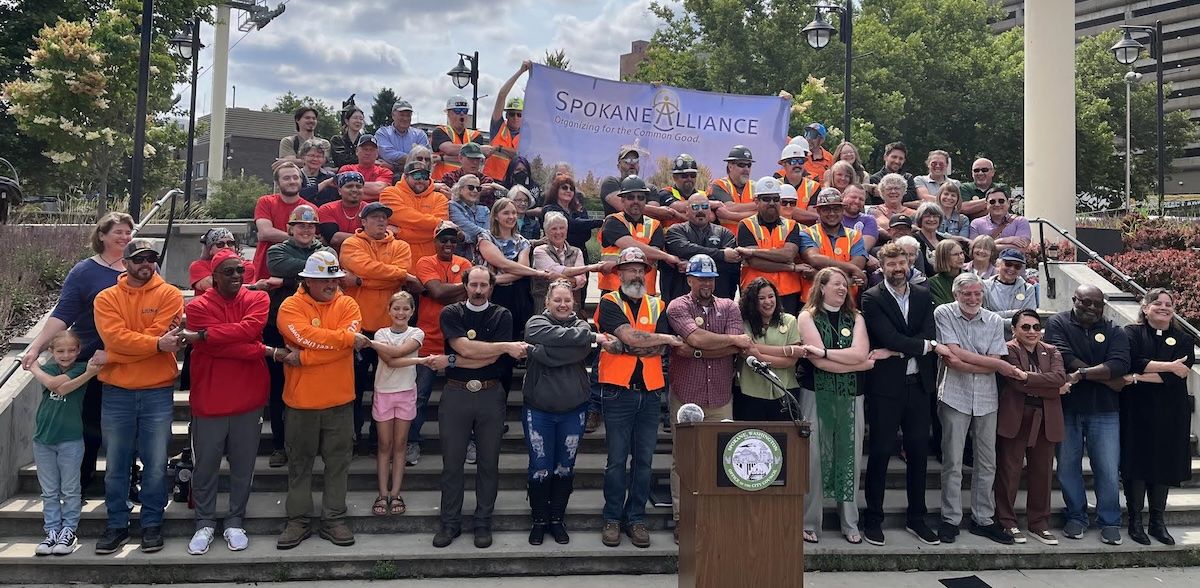
The ordinance, named the “Public Dollars for Public Benefit Ordinance,” is being proposed by the Spokane Alliance and is being supported by Spokane City Council Members Paul Dillon and Zack Zappone. Council Member Lili Navarrete also attended the event.
The ordinance sets rules about how taxpayer funds can be spent on public infrastructure. The rules are based on Community workforce agreements (CWAs) and project labor agreements (PLAs).
The proposed CWAs and PLAs establish priority hire requirements and pre-apprenticeship programs focused on economically-distressed areas in Spokane and ensuring benefits for workers, including full-family medical coverage and multi-employer retirement plans.
Multiple speakers representing labor and community organizations spoke at the event, explaining how they thought the ordinance would benefit Spokane’s community members.
They emphasized how the ordinance would increase accountability for construction contracting companies, provide opportunities through apprenticeship programs, provide stability for employees and prioritize Spokanites as recipients of Spokane’s funding.
How faith communities are involved
Council Member Paul Dillon, speaking in support of the ordinance, said the proposal emphasizes dignity — common ground for many faith communities.
“I believe that a lot of our faith leaders are here because really this comes down to dignity. This is about lifting up all people, and I think that there’s a very moral argument for that that has its foundation in faith and I think it speaks volumes that there are different clergy that are here in support of this ordinance,” he said.
Faith leaders at the event echoed this theme, citing their moral obligation to support all people as motivation for backing the proposal.
“It’s a matter for people of faith in Spokane because this is about dignity, it’s about honoring people’s abilities and their presence and their personhood,” said the Rev. Kimberly Meineke from St. David’s Episcopal.
“This is also about dignity, it’s about a sense of belonging,” Kuenker said.
She explained that her friends through Spokane Alliance who represent labor communities talk with pride about the impact they have on Spokane through their work.
“The sense of community ownership that that provides, the sense of well-being, the sense of this is your home and you belong here, that’s about spiritual well-being,” she said.
How the approach involves multiple faith communities
Besides the event having speakers from multiple Christian denominations, Spokane Alliance — which proposed the CWA — is a coalition that involves multiple faith communities.
“Knowing who my colleagues are here in the Spokane Alliance, I would say that we do work ecumenically and that care for people, that care for their wellbeing, doesn’t belong to one denomination. That belongs to all of us,” Kuenker said.
“It gets at a lot of the core Christian values that I know are shared with a lot of other faith communities, around justice and equity and making sure that we’re taking care of the world in a way that creates space for everybody to live and grow,” Feeny said.
This ordinance is not the first proposal Spokane Alliance and the faith communities involved have proposed with the Spokane City Council. Ten years ago, they passed the Sick, Safe and Family Leave with Council Member Dillon.


